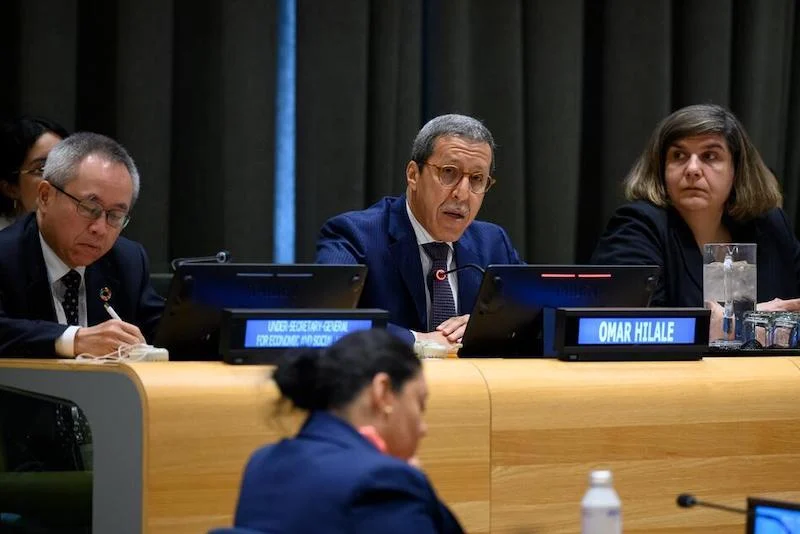
UN Security Council resolution 2797 adopted last year facilitated direct discussions among the four parties to the Sahara conflict (Algeria, Morocco, Mauritania & Polisario) under the UN-U.S. auspices, said on Tuesday Morocco’s Permanent Representative to the UN Omar Hilale.
Addressing UN fourth Committee convening in New York, the Moroccan diplomat said resolution 2797 has enabled Morocco to present its detailed Autonomy Plan offered for the Sahara under its sovereignty, outlining the functions, powers, and responsibilities of the executive, legislative, and judicial branches.
This Autonomy Plan, endorsed by the UNSC, “reconciles political realism, democratic governance, and the aspirations of the people,”, he added, noting that the UNSC has called upon the four parties to the Sahara conflict to engage, in good faith and without preconditions, in the search for a definitive political solution.
He cited in this regard the three quadripartite meetings held in Washington and Madrid to advance the political process, stressing that this unprecedented momentum requires each party to assume its historic responsibility in implementing resolution 2797.
UN Security Council resolutions “must be implemented; discussions must be conducted without preconditions; good faith must be demonstrated; commitments undertaken must be honored; and the ceasefire must be re-established and observed,” said Morocco’s Ambassador to UN.
Beyond its political dimension, Resolution 2797 and the negotiating momentum it has generated carry, above all, a humanitarian promise, he said, noting that “behind every resolution, there are women, men, and young people waiting in the Tindouf camps.”
The situation in these camps, hosting the world’s second-longest-running refugee crisis, cannot continue for another half-century, said Mr. Hilale, calling for lasting solutions for the people in the Tindouf camps under international law, doctrine and practices of the UN High Commissioner for Refugees.
The lasting solutions include voluntary repatriation, resettlement in a third country, or integration into the host country, according to the free and voluntary choice of these populations, said the Moroccan diplomat, warning that any procrastination or act of imposing conditions will be legally unlawful, politically immoral, and reprehensible from a humanitarian standpoint.
In his response to misleading propaganda about the Sahara issue, Mr. Hilale said decolonization of the Sahara was definitively sealed half a century ago, with the return of the Sahara to its motherland, Morocco, thanks to the Green March and in accordance with the Madrid Agreement.
UNSC resolution 2797 reinforced Morocco’s legitimate rights with the adoption Autonomy plan in the Sahara under Moroccan sovereignty, he stressed.
Algeria, he said, has been clearly identified by the UNSC among the four parties to Sahara regional conflict, refuting the Algerian regime attempts to skip its responsibility as the country hosts, arms and funds the Polisario armed militias.
Ambassador Hilale also spoke about the advisory opinion of the International Court of Justice (ICJ), which was cited several times at the Fourth Committee. The ICJ’s advisory opinion has established two political and historical truths: the first is that Morocco was present in its Sahara long before Spanish colonization; secondly the Court has confirmed the existence of ties of allegiance between the sultans of Morocco and the tribes of the Sahara.