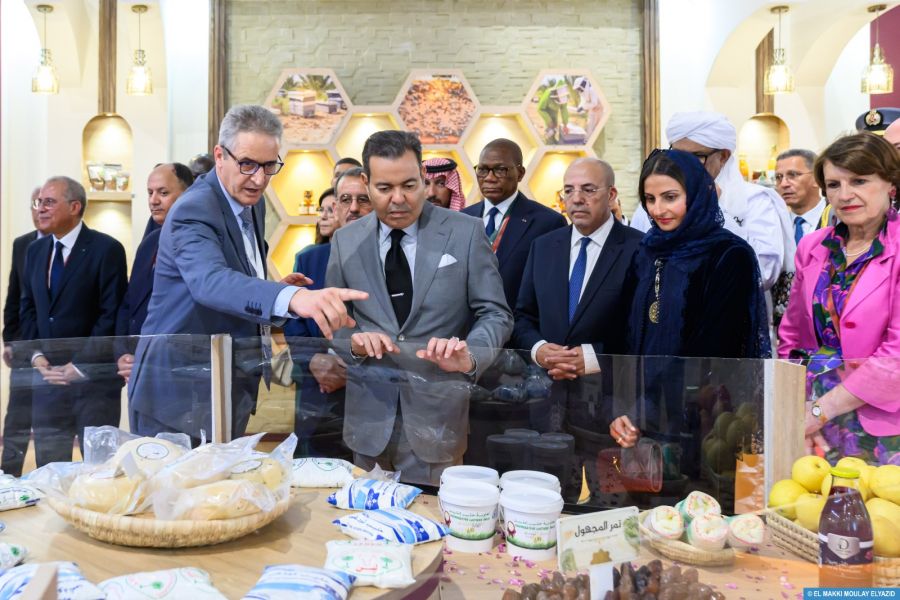
Prince Moulay Rachid presided over the opening ceremony of the 18th edition of the Salon International de l’Agriculture au Maroc (SIAM) in Meknès on Monday, launching an event that will run until April 28 under the theme “Sustainability of Animal Production and Food Sovereignty.”
The Salon, held under the High Patronage of King Mohammed VI, extends over a 37-hectare site and draws participation from 70 countries, with Portugal serving as the guest of honor — a choice that reflects the depth of relations between Rabat and Lisbon.
The opening ceremony included the conferral of geographical indication and origin designation certificates to representatives of agricultural cooperatives and economic interest groups from across Morocco’s regions. Among the designations awarded were the “Amandes de Ghassate” geographical indication for the Draa-Tafilalet region, the “Cumin beldi d’Alnif” appellation of origin, the “Piment doux Ouled Ali Fkih Ben Saleh” indication for the Béni-Mellal Khénifra region, and the “Huile d’olive vierge extra El Kelâa des Sraghna” indication for the Marrakech-Safi region.
These certifications signal Morocco’s growing investment in the protection and valorisation of its territorial agricultural heritage.
This year’s thematic focus on animal production sustainability reflects both the sector’s economic weight and the policy challenges it faces. Livestock farming is central to rural livelihoods across much of Morocco, yet it remains exposed to climate variability, rising input costs, and the structural question of food sovereignty. The salon’s program highlights achievements in animal health, welfare, and zootechnical performance, as well as the economic outcomes of the livestock value chains under Morocco’s Green Generation agricultural strategy.
The event brings together more than 1,500 exhibitors, 500 cooperatives, 200 livestock farmers, and 45 foreign delegations, with an expected attendance of over 1.1 million visitors. Alongside Portugal, the delegations present include Cameroon, Côte d’Ivoire, France, Mali, Madagascar, Uganda, Poland, Turkey, and others, reflecting SIAM’s established status as one of Africa’s major agricultural showcases. The salon also features thematic pavilions on precision agriculture, agri-food processing, environmental sustainability, and rural digitalization.
Since its founding, SIAM has grown from a domestic showcase into a platform of international significance, consistent with the Royal vision for a modern, competitive, and globally integrated agricultural sector. The 2026 edition arrives at a moment of renewed momentum for Moroccan agriculture, with the country posting notably favorable rainfall levels this season and major investments in irrigation, value chain development, and agri-industrial ecosystems continuing to bear fruit across the country’s twelve regions.
Combining technological innovation, international cooperation, and the enhancement of agricultural heritage, the Exhibition embodies the Kingdom’s ambition to build a high-performing, sustainable, and competitive agriculture on both regional and global scales.