“The Netherlands considers that genuine autonomy under Moroccan sovereignty is the most feasible solution” to the dispute over the Sahara, said Dutch Foreign Minister, Tom Berendsen.
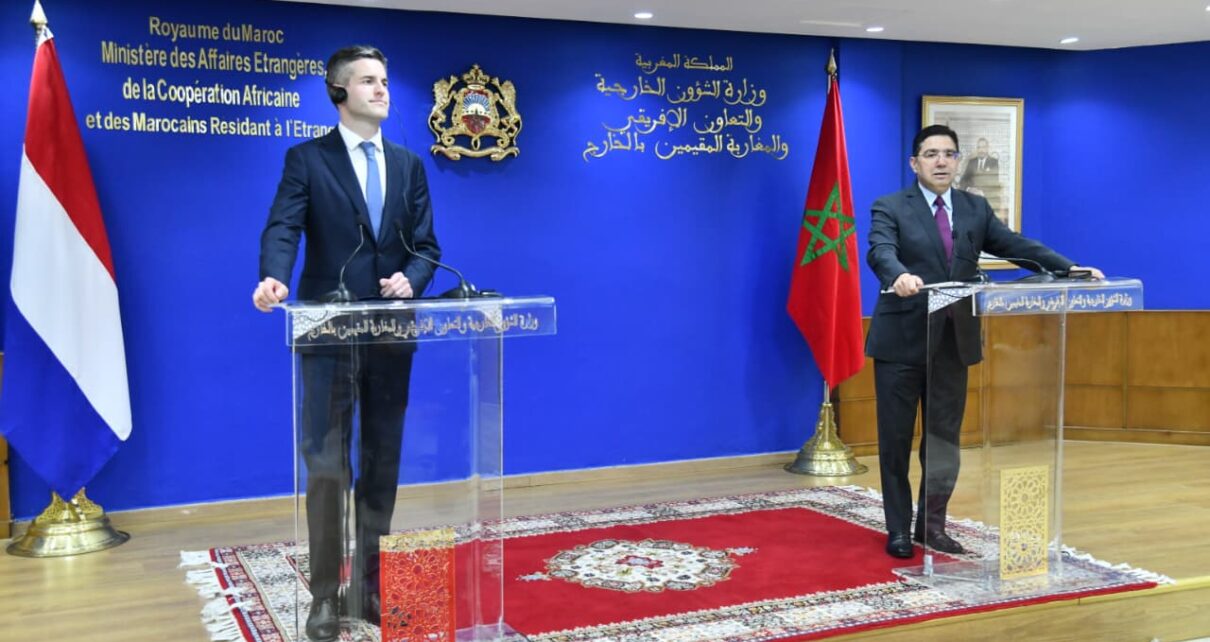
The stand was expressed by the Dutch official in a press briefing following a meeting in Rabat Tuesday with his Moroccan peer Nasser Bourita.
This position was also affirmed in a Joint Communiqué issued following talks between Bourita and Berendsen, who is on a working visit to Morocco April 7-8, his first outside the European Union, since he became member of the Dutch cabinet.
Berendsen further reaffirmed the Netherlands’ support for United Nations Security Council Resolution 2797, as well as for the efforts of the UN Secretary-General’s Personal Envoy, Staffan de Mistura, to “facilitate and conduct negotiations based on the autonomy plan proposed by Morocco, with a view to achieving a just, lasting, and mutually acceptable political solution.”
“The Netherlands will act in line with its position, including at the diplomatic and economic levels, in accordance with international law,” the Dutch Foreign Minister was quoted as saying in the joint communiqué.
In his press briefing, the Dutch Top Diplomat also pointed out that Morocco, under the leadership of King Mohammed VI, establishes itself as a trustworthy partner and a committed player to global peace and stability.
Berendsen affirmed that his country highly appreciates the personal engagement of King Mohammed VI, in his capacity as Chairman of the Al-Quds Committee, in favor of the Palestinian cause.
“We highly praise the fruitful cooperation with Morocco during the recent session of the Global Alliance for the Implementation of the Two-State Solution,” he stated further, reiterating the commitment of the Netherlands and Morocco to this solution.
Touching on the progress scored by Morocco, the Dutch official described this progress as remarkable and hailed the cutting-edge infrastructure of the Kingdom, as well as the major economic and investment opportunities offered by the country.
In the current global geopolitical context, Morocco is a strategic and leading partner for the Netherlands, given its close ties with West Africa, the Sahel and Gulf countries, Berendsen noted.
In this regard, he hailed the active role played by Morocco in supporting development and stability in the Sahel region.
During the press briefing, Bourita praised the new momentum that marked relations between the two Kingdoms in recent years, underlining that the evolution of these relations aligns with the principle set by King Mohammed VI for the Kingdom’s foreign policy, namely clarity and ambition, which helped establish strong bilateral relations based on mutual respect, transparency, responsibility, and a genuine partnership that takes into account each party’s priorities.
He also noted that the position expressed by the Netherlands last December regarding the Moroccan Sahara marked a major turning point in bilateral relations. He pointed out that this constructive stance is consistent with international law and UN resolutions, particularly UN Security Council Resolution 2797.
The Netherlands’ position has also served as a significant lever to strengthen bilateral ties and enhance partnership between two influential regional actors on the international stage, he said.
In this regard, he noted that the Kingdom of the Netherlands—being a key player within Europe, a strong advocate of a solid Euro-Moroccan partnership, and a respected and influential actor at the United Nations and multilateral level, has become a leading partner for Morocco in political dialogue.
Bourita also indicated that Africa is one of the pillars of bilateral relations, adding that both sides will work to encourage Moroccan and Dutch private sectors to boost investment and seize business opportunities across the continent.