The government of Egypt has reiterated firm support for Morocco’s territorial integrity and UN Security Council resolution 2797 endorsing Autonomy plan in the Sahara under the Kingdom’s sovereignty as the most feasible solution to the decades-long conflict.
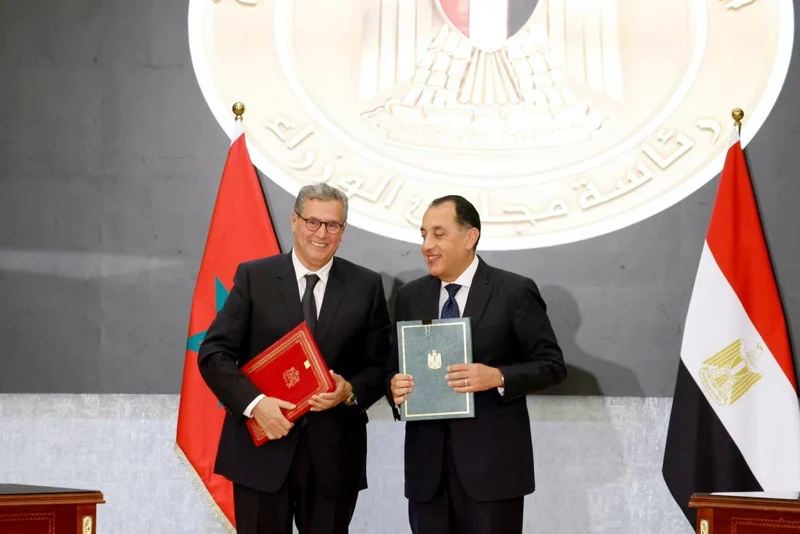
The supportive stand comes in a joint statement issued Monday in Cairo after the 1st meeting of Morocco-Egypt Coordination and Follow-up Committee, held under the co-chairmanship of Morocco’s Head of Govt. Aziz Akhannouch and Egyptian PM Mostafa Madbouly.
Egypt also hailed the role of King Mohammed VI, Chairman of the Al-Quds Committee, in supporting the resilience of the people of Al-Quds and safeguarding the Arab and Islamic cultural and religious identity of the city of Al-Quds, as well as its legal status, its civilizational significance, and its historical importance as a land of coexistence among the three religions.
Furthermore, Cairo commended the royal initiative launched for Sahel countries to enable them access to Atlantic Ocean and the Africa-Atlantic gas pipeline project which aims at transporting natural gas across 13 West African nations to Morocco and further north to Europe.
The landmark energy linking Nigeria to Morocco serves as a catalyst for economic, industrial, and digital development, a pillar for job creation, and a cornerstone in building a major corridor linking Europe, Africa, and the Atlantic basin.
In his opening address, Akhannouch said this meeting reflects the ambition of both countries’ leaders, King Mohammed VI and President Abdel Fattah Al-Sissi, to give new impetus to bilateral ties and elevate them to a comprehensive and exemplary strategic partnership, based on solidarity, economic integration and political coordination on regional and international issues.
“Our strong bilateral ties are also built on our clear stances regarding strategic issues facing both our countries,” said Akhannouch, stressing the need for a balanced increase in the volume and value of bilateral trade, while taking advantage of opportunities offered by FTAs provisions at the regional and continental levels.
He also called for the removal of all administrative barriers to ensure the smooth flow of goods between the two countries and to promote two-way investment flows.
For Akhannouch, an economic integration between the two countries, based on the win-win principle, hinges on direct logistics and maritime connectivity between the Port of Tangier Med and East Port Said, as well as the Suez Canal corridor—turning the two countries into an integrated platform and a gateway to African, European, and Asian markets.
He also called for the establishment of a Morocco-Egypt investment platform, enhancing the exchange expertise & experiences in solar & wind energy projects, and stronger regional cooperation in renewable energy, particularly green hydrogen.
Akhannouch stressed the need of reviewing the legal framework governing relations between the two countries in order to keep pace with rapid global changes and challenges.
The first session of the Morocco-Egypt Coordination and Follow-up Committee highlighted by the signing of 14 cooperation agreements and MoUs Covering several sectors, including housing and urban development, tourism, energy, education and training, health and pharmaceutical sectors, customs, industry, fight against desertification, water resource management, as well as youth, sports, and culture.