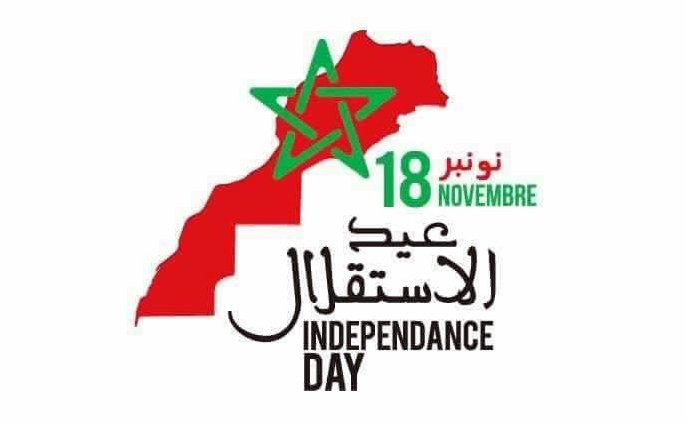
Morocco commemorates this November 18 it’s its 70th Independence Day, marking not merely the date King Mohammed V ascended the throne in 1927, but celebrating a complex national journey forged through decades of resistance against colonial rule and a long national struggle to defend the unity, sovereignty, and core values of the country, thanks to the perfect harmony between the throne and the people.
Engraved into the annals of the Kingdom’s history and in the hearts of all Moroccans, Independence Day is an opportunity to recall the historical context of this epic event that marks the triumph of the shared will of the throne and the people, united in a long battle to free the country from colonial rule and lay the foundations for an independent Morocco, destined for a bright future.
The path to independence began with the 1912 Treaty of Fez, which divided Morocco among France, Spain, and an international regime controlling Tangier. This fragmentation forced Moroccans to develop diverse resistance strategies, from armed mountain confrontations to organized urban political movements.
Early revolts emerged immediately after colonial imposition. The Chaouia tribes rose in 1907, Fez experienced its “Bloody Days” in 1912, and Mohammed Ben Abdelkrim El Khattabi led sustained Rif mountain resistance until 1926. These conflicts required protectorate forces to conduct military operations spanning more than two decades.
Political mobilization intensified following the 1930 Berber Decree, which attempted to separate Amazigh regions from Islamic institutions. Rather than dividing the population, this measure unexpectedly unified Moroccans, strengthening the nascent independence movement throughout the 1930s.
The 1944 Independence Manifesto marked a decisive moment when sixty-six Moroccans formally demanded full sovereignty, distributing their document to international diplomats. Colonial authorities responded with arrests and censorship, yet momentum continued building up.
Sultan Mohammed V’s 1953 exile to Madagascar did not weaken the momentum of the national struggle, instead it triggered widespread uprisings and armed resistance in cities and villages across Morocco.
The entire national territory witnessed numerous heroic battles and popular uprisings that embodied the Moroccan people’s resistance against foreign presence and colonial domination. Among these, it is worth mentioning the battles of El-Hri, Anoual, Bougafer, Djebel Baddou, Sidi Bou Othmane, as well as the uprisings of the Aït Baâmrane tribes, the Southern provinces, and other historical events where resistance fighters inflicted heavy defeats on colonial forces.
Facing mounting pressure and concurrent crises in Algeria, France entered negotiations that were crowned by the return home of King Mohammed V on November 16, 1955, and the declaration of independence two days later, sealing thus the triumph of the joint struggle of the King and the People.
Territorial reunification continued through subsequent decades. Tangier’s international status ended in 1956, followed by Tarfaya’s recovery in 1958, Sidi Ifni in 1969, and southern provinces after the 1975 Green March.
The celebration of Independence Day is an opportunity to revisit the glorious pages of Morocco’s history, filled with heroic acts and sacrifices made to defend the sacred values of the nation. It is also an opportunity to draw the necessary lessons from this historic event to instill the spirit of citizenship in new generations, who are called upon to engage in another equally fundamental struggle—to preserve democratic achievements and consolidate the territorial integrity of the country.
Today’s commemorations also reflect ongoing development under King Mohammed VI, with infrastructure and social programs building upon foundations established during the post-independence era.