Both presidents of Tunisia and Algeria have sided with Iran, echoing its anti-American and anti-Israeli rhetoric for decades. But once the US and Israeli strikes began, both kept silent, voicing ambiguous stands.
Iran’s late president Ebrahim Raisi visited Algiers in March 2024. Tebboune publicly embraced Iran as a strategic partner, framing Palestine as the ideological glue binding the two regimes.
Algeria has long sided with Tehran, allowing Iran to operate on its territory, including through training for the Polisario, a factor that led Morocco to cut diplomatic ties with Iran in 2018.
Tebboune has also praised Iran’s technological model and maintained close coordination with Tehran within OPEC+. Both countries signed cooperation agreements covering hydrocarbons, communications, sports and tourism, and established a follow‑up mechanism known as the Higher Algerian‑Iranian Commission.
But as Iran now absorbs successive US and Israeli strikes aimed at crippling its military capabilities, Algeria has effectively “swallowed its tongue.” Its responses have been vague, carefully avoiding explicit support for Tehran while also failing to back Arab Gulf states targeted by Iranian missiles.
Despite years of rhetoric about resisting “Western imperialism,” Algeria appears to be tacitly accepting the current US–Israeli campaign.
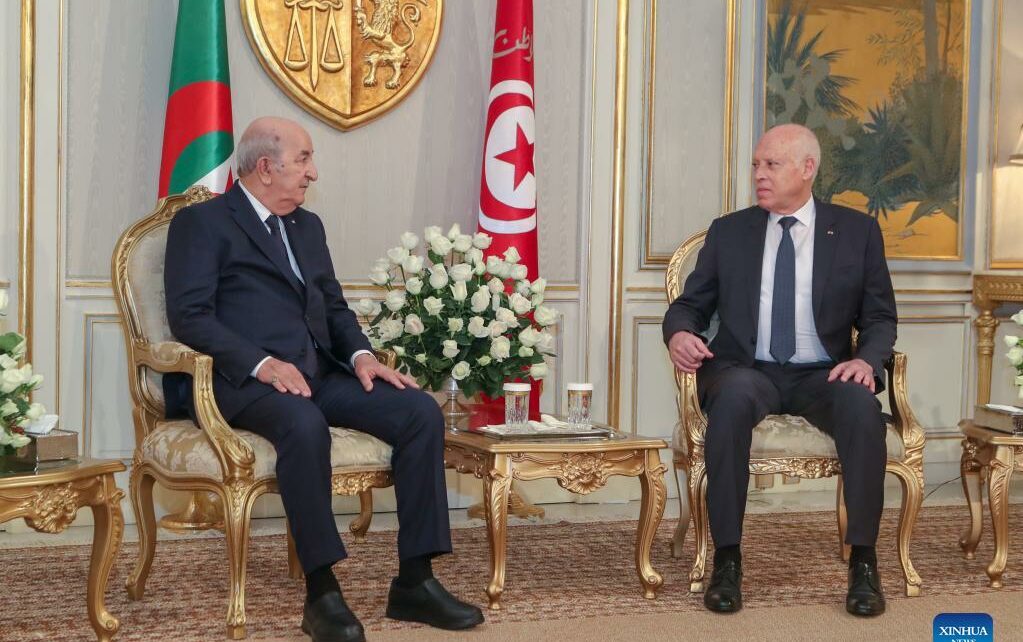
Kaïs Saïed – whose regional posture mirrors Algiers- became the first Tunisian president to visit Tehran when he attended Raisi’s funeral in May 2024. During that visit, Saïed was received by Supreme Leader Ayatollah Ali Khamenei, a significant diplomatic signal from Tehran to Tunis.
At the time, Saïed openly rejected the two‑state solution and echoed both Iran and Algeria’s anti‑Western and anti‑Israel rhetoric. His outreach to Tehran was widely seen as an attempt to align with like‑minded authoritarian leaders driven by ideological hostility toward Israel and the West.
Khamenei praised Saïed’s “anti‑Zionist position,” while Saïed called on the Muslim world to abandon its “passive posture.”
Today, that defiance has evaporated. As Israel and the US intensify strikes on Iran, Tunisia – just like Algeria – has limited itself to a mild, non‑committal statement expressing sympathy for “all victims” and calling for de‑escalation.
The US–Israel confrontation with Iran has exposed states whose diplomatic positions rest more on rhetoric than on clear, actionable policy. It has also laid bare the inconsistencies of regimes that sought to posture against the West but now hesitate to speak as Iran comes under unprecedented military pressure.
Gulf capitals are likely to take note of which Arab governments demonstrated steadfast solidarity and which, like Tunisia and Algeria, responded with ambiguity at a moment of geopolitical rupture.