The Central African Republic chose Casablanca as the strategic venue to unveil its ambitious National Development Plan 2024-2028, valued at approximately 7,000 billion CFA francs ($10.7 billion).
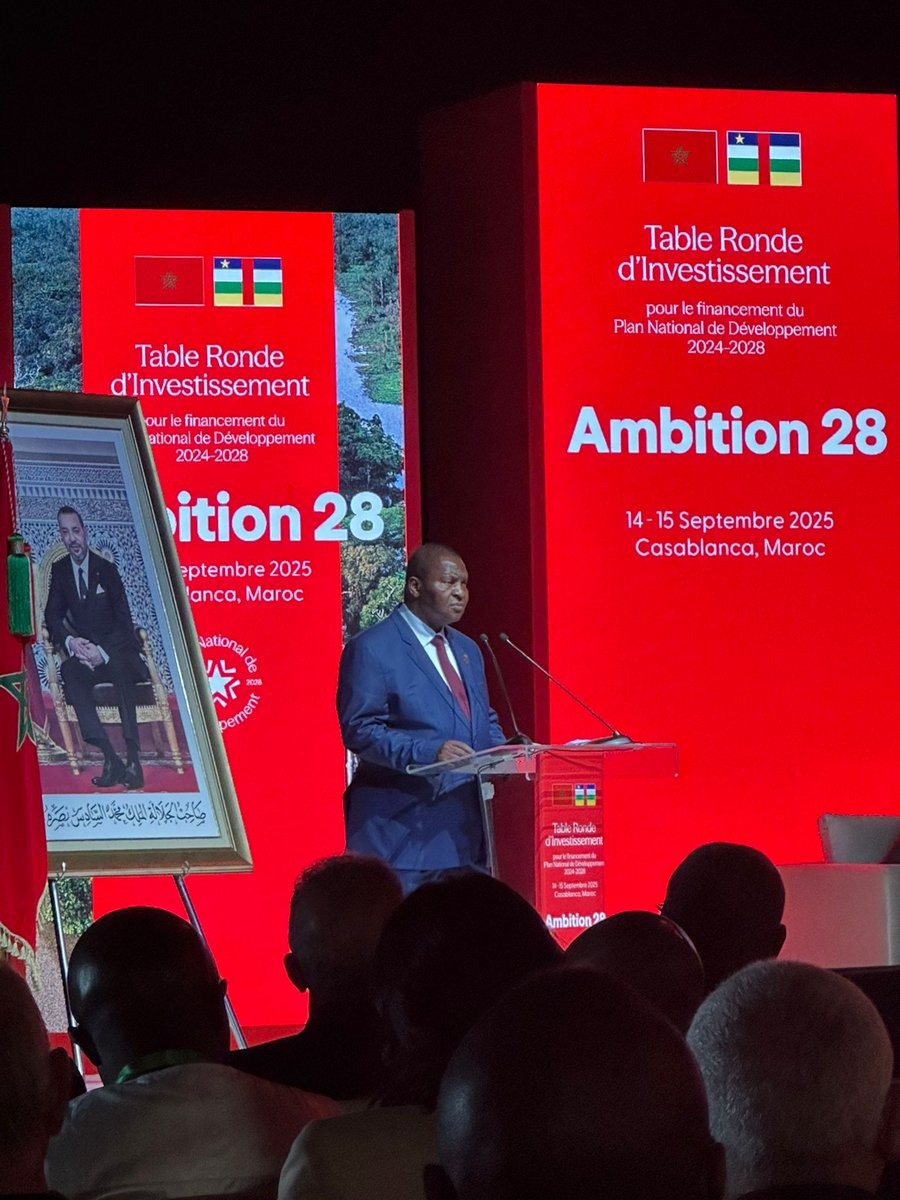
This came during an Investment Round Table dedicated to financing the Central African Republic’s National Development Plan 2024-2028. The round table, held September 14-15, 2025, transformed Morocco’s economic capital into an international crossroads for donors and investors examining the strategy of a nation historically associated with conflict and instability.
President Faustin-Archange Touadéra justified this location by citing “excellent historical relations” with Morocco and King Mohammed VI’s commitment to African prosperity. Beyond diplomatic rhetoric, CAR positioned itself within Casablanca’s expanding financial ecosystem. Casablanca Finance City, ranked first in Africa on the Global Financial Centers Index, now hosts over 220 banking institutions, insurers, and investment funds operating across the continent.
“Every dollar invested in the National Development Plan represents a commitment to peace and sustainable development,” emphasized Morocco’s Minister of Economy and Finance, Nadia Fettah Alaoui, during the inaugural session. She noted that this two-day gathering illustrates “the Kingdom’s ongoing commitment to South-South cooperation and assistance to development” for this country.
This message clearly signals Bangui’s strategy to leverage a recognized hub for credibility and diversify financing sources beyond traditional budgetary support.
The $10.7 billion envelope positions CAR at intermediate levels compared to other African development plans. Senegal launched its Emerging Senegal Plan (PAP3) in 2024 for $41.4 billion, while Niger presented its “Renaissance III” program in 2022 worth $29.6 billion. Gabon calibrated its Transformation Acceleration Plan at approximately $4.5 billion, primarily for post-COVID economic recovery.
These comparisons highlight the Central African program’s relative modesty but also its realism. With foreign direct investment flows to CAR not exceeding $30 million in 2023 according to UNCTAD data, the strategy prioritizes credibility and momentum effects over aggressive targets.
Within the Central African Economic and Monetary Community, CAR lags significantly. Cameroon attracted $680 million in FDI during 2023, Chad approximately $780 million, and Congo $530 million, primarily in hydrocarbons. For Morocco, hosting this conference reinforces its African strategy after investing nearly $2.4 billion across the continent in 2024, consolidating its role as a South-South platform.