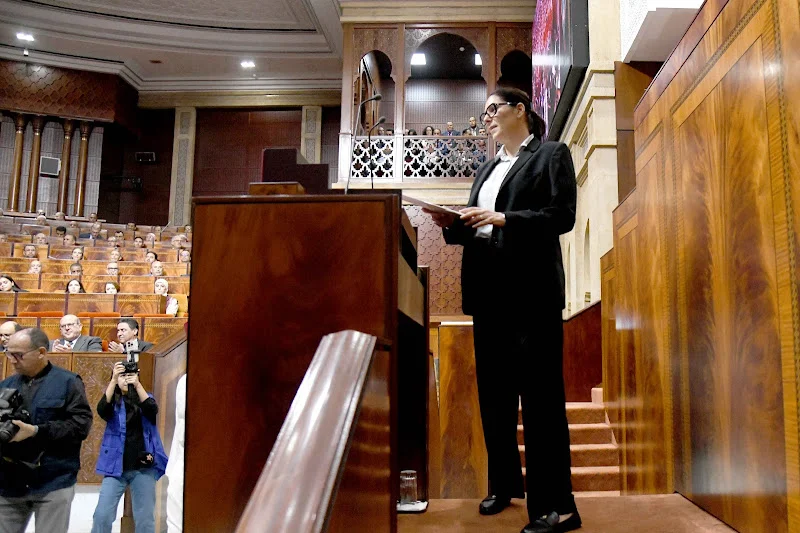
The Moroccan Sahara remains at the forefront of national causes, Head of Government Fatima Ezzahra El Mansouri said on Monday in Rabat, stressing that the Government will continue to defend the Kingdom’s sovereignty, territorial integrity and interests.
Presenting the Government Program before both Houses of Parliament, El Mansouri said that, building on the pivotal milestone of UN Security Council Resolution 2797, the government will continue to garner support for the autonomy initiative under Moroccan sovereignty, while accelerating development in the Southern Provinces, a genuine gateway to the Kingdom’s African hinterland and Atlantic space.
She also reaffirmed the government’s steadfast commitment to Morocco’s stance on the Palestinian cause and Al-Quds Asharif, under the leadership of King Mohammed VI, Commander of the Faithful and Chairman of the Al-Quds Committee, as well as to a peaceful resolution based on the two-State solution to achieve a just and lasting peace.
The Head of Government further noted that the Government Program is grounded in the Nation’s fundamental principles, namely the tolerant Islamic religion, constitutional, democratic, parliamentary and social Monarchy, national unity and territorial integrity, as well as the democratic choice, while safeguarding cultural and linguistic diversity, equality, rights and freedoms, and equal opportunities.
She stressed that the High Royal Guidelines are the primary reference framework for government action, recalling that the King called, in the 2026 Throne Speech, for launching a new cycle in the country’s development trajectory, centered on preserving achievements and pursuing major projects and reforms.
In the Royal Speech to Parliament on the occasion of the opening of the first session of the first legislative year of the 12th Legislature, on October 9, the Monarch also reiterated the challenges facing the country at this stage, including achieving a balance between economic growth and social and territorial justice, placing young people at the heart of public policies, and establishing the private sector as a strategic player, she recalled.
These challenges include accelerating projects related to water, energy and food security, industrial development, the digital economy and artificial intelligence, in addition to fully implementing advanced regionalization and administrative de-concentration, she explained.
The government, El Mansouri noted, is guided by the New Development Model and the “Morocco 2035” ambition, which are based on a productive economy, skilled human capital, broader inclusion, sustainable territorial development and an efficient State that unleashes potential while safeguarding the public interest.
The Government also draws on assessments of previous experiences, she said, noting that it will work to enshrine the achievements made in social protection, as well as reforms in healthcare, education, investment, aid, housing, water, energy and basic infrastructure. It will also seek to address shortcomings in translating investment into jobs, improving services and ensuring fairness, she added.
El Mansouri affirmed further that the Government Program is based on “the convergence of the reference frameworks of the majority parties, their programs and their electoral commitments, which the government will gradually implement, in keeping with operational feasibility and the sustainability of public finances.”