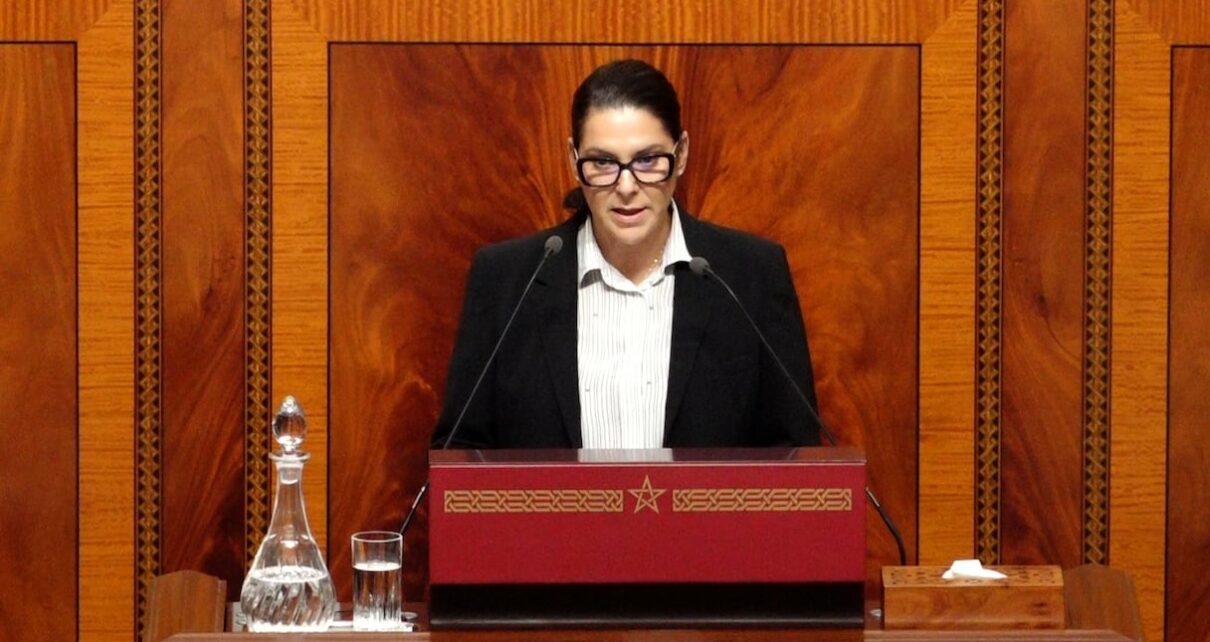
Morocco’s newly appointed head of the government Fatima Ezzahra El Mansouri has placed the fight against corruption and rent-seeking at the forefront of the government’s 2026–2031 program.
In her inaugural policy address before members of the parliament, El Mansouri stressed that public institutions will not regain citizens’ trust without a genuine crackdown on corruption and conflicts of interest.
The government commits to completing the national integrity system by criminalizing illicit enrichment, punishing conflicts of interest in line with Article 36 of the Constitution, strengthening compulsory asset declarations, and outlawing the disclosure of information for personal gain.
A structural reform of market regulation will target monopolies and opportunistic intermediation, coordinated with the Competition Council, she said.
Public procurement will face closer scrutiny for collusion, while contractors will be legally required to allocate 30% of contract value to Moroccan small and medium-sized enterprises.
Alongside integrity measures, the program focuses on protecting household purchasing power amid rising living costs.
Strategies include enhancing family incomes, controlling price drivers, expanding social protection and delivering better public services.
Food price stabilization will rely on supply plans for strategic products, regional platforms linking producers to consumers, reformed meat and fish distribution channels, and clearer rules balancing exports with domestic supply.
Eligible households will receive automatic social compensation equivalent to monthly electricity bills under 100 dirhams for their primary residence, without paperwork or administrative visits.
A gradual income-tax reform aims to raise net salaries for employees and encourage formal employment.
Social support will be recalibrated on actual income, rising from 500 to 1,000 dirhams by the end of the term and transformed into an inclusion tool.
Coverage of unemployment benefits will expand. A comprehensive pension reform, conducted through social dialogue, seeks coherent protection, gradual increases in the minimum pension to 3,000 dirhams monthly across schemes, and full pensions for widows equal to 100% of the deceased spouse’s main pension.
Broader inequality measures include accelerating territorial justice, improving public education and healthcare quality, advancing advanced regionalisation with higher financial transfers to regions (at least 12 billion dirhams from 2027), and a dedicated youth strategy addressing the 2.9 million young people outside education, training or work.
Housing policies will shift toward affordable, well-located homes, including 100,000 rural units with direct support of 40,000 dirhams per eligible family.


