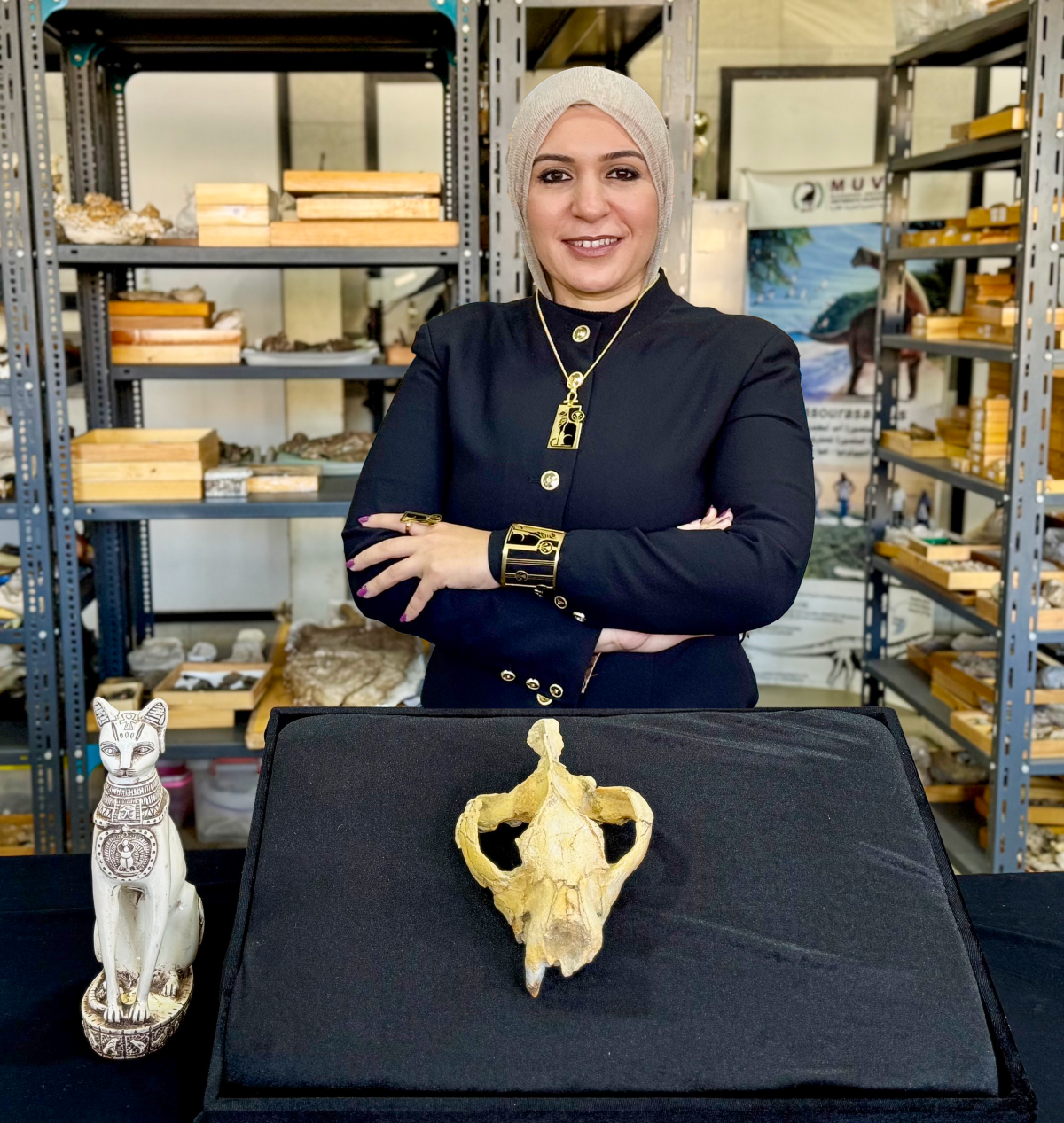
A rare fossil uncovered in Egypt’s Fayum Desert has led to the identification of a new species of apex predator, named Bastetodon. This remarkable discovery, published in the Journal of Vertebrate Paleontology, offers fresh insights into the evolution of ancient carnivorous mammals that once dominated African ecosystems. The fossil belongs to the hyaenodonts, an extinct group of carnivores that reigned long before modern predators like lions and hyenas.
Bastetodon, a leopard-sized predator, boasted powerful jaw muscles and sharp teeth, suggesting it hunted a variety of prey, including primates, early hippos, elephants, and hyraxes in what was once a lush forest.
The fossil was unearthed by a team of researchers led by Shorouq Al-Ashqar, a PhD student at the Mansoura University Vertebrate Paleontology Centre and a research assistant at the American University in Cairo. Al-Ashqar described the discovery as an exhilarating moment, recounting how a team member spotted large teeth protruding from the ground, leading to the unearthing of a nearly complete skull of this ancient predator.
The name Bastetodon is derived from Bastet, the ancient Egyptian goddess of protection and power, symbolising the strength of the predator. The research also identified another extinct genus, Sekhmetops, named after Sekhmet, the lion-headed goddess of war. The study highlights how hyaenodonts once thrived across Africa before expanding into Asia, Europe, and North America. However, with changing climates and the rise of new predators, these ancient carnivores eventually vanished. Al-Ashqar emphasised the importance of this discovery in understanding the evolution of prehistoric carnivores and their global distribution, with hopes that further research will reveal more about these fascinating creatures.