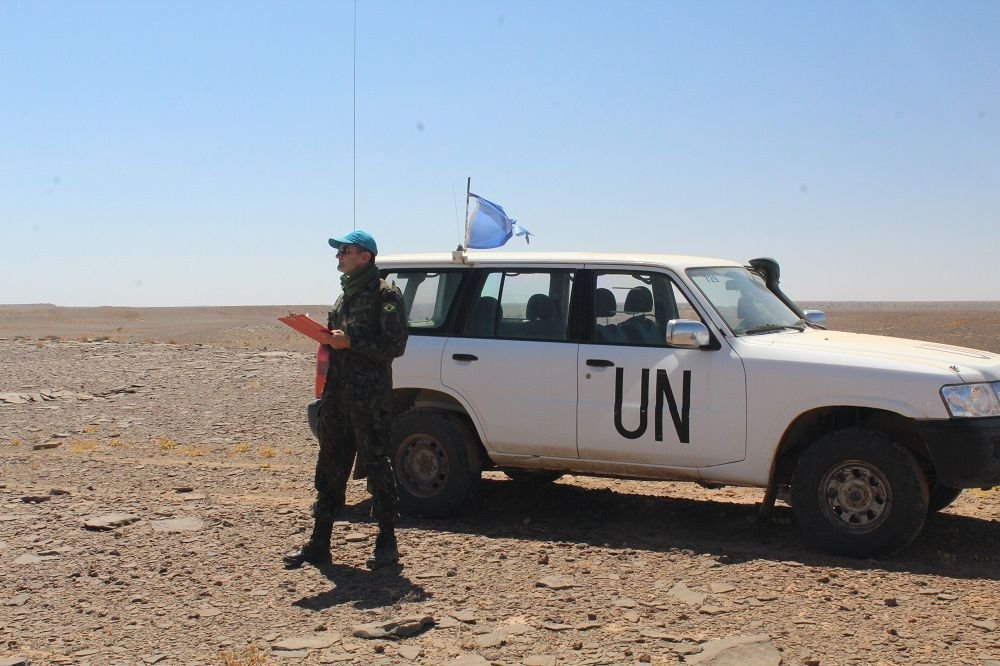
The relationship between Morocco and the UN mission in the Sahara territory (MINURSO) was marked by persistent tensions and disagreements throughout its more than three decades of existence.
Created on 29 April 1991 by UN Security Council Resolution 690, MINURSO was tasked with monitoring the ceasefire that took effect on 6 September that year.
The mission established nine observation posts – four west of the sand berm (at Es-Smara, Mahbas, Oum Dreiga and Aousserd) and five to the east (at Bir Lahlou, Tifariti, Mehaires, Mijek and Agounit) – along with a headquarters in Laayoune and a liaison office in Tindouf, Algeria.
From the outset, Rabat raised objections.
On 26 September 1991, just weeks after the ceasefire began, Morocco formally protested the presence of Polisario fighters in areas under MINURSO supervision, particularly around Tifariti.
King Hassan II wrote to then-UN Secretary-General Javier Pérez de Cuéllar demanding their withdrawal. Similar complaints were reiterated by Moroccan diplomacy in 1992, 2005 and 2006.
Tensions reached a peak in March 2016 after UN Secretary-General Ban Ki-moon showed pro-seaparatist bias when he visited the Tindouf camps and Tifariti.
Morocco responded by expelling around 80 civilian members of the mission, triggering a serious crisis with the United Nations.
The civilian presence was temporarily reduced before relations were gradually normalized.
In more recent years, MINURSO itself scaled back operations. In September 2025 it closed three observation posts, and the following month it stopped using a helicopter for ceasefire monitoring. These cuts contrasted with earlier plans, such as a proposed helipad at Tifariti in 2017.
The end of the mission’s mandate on 31 October 2026 brought the long-running friction into sharp focus.
A Royal Cabinet statement described MINURSO as having long served as “an instrument of internationalization of the regional dispute.”
MINURSO has now entered its liquidation phase after more than 35 years of operations that served to perpetuate the status quo.