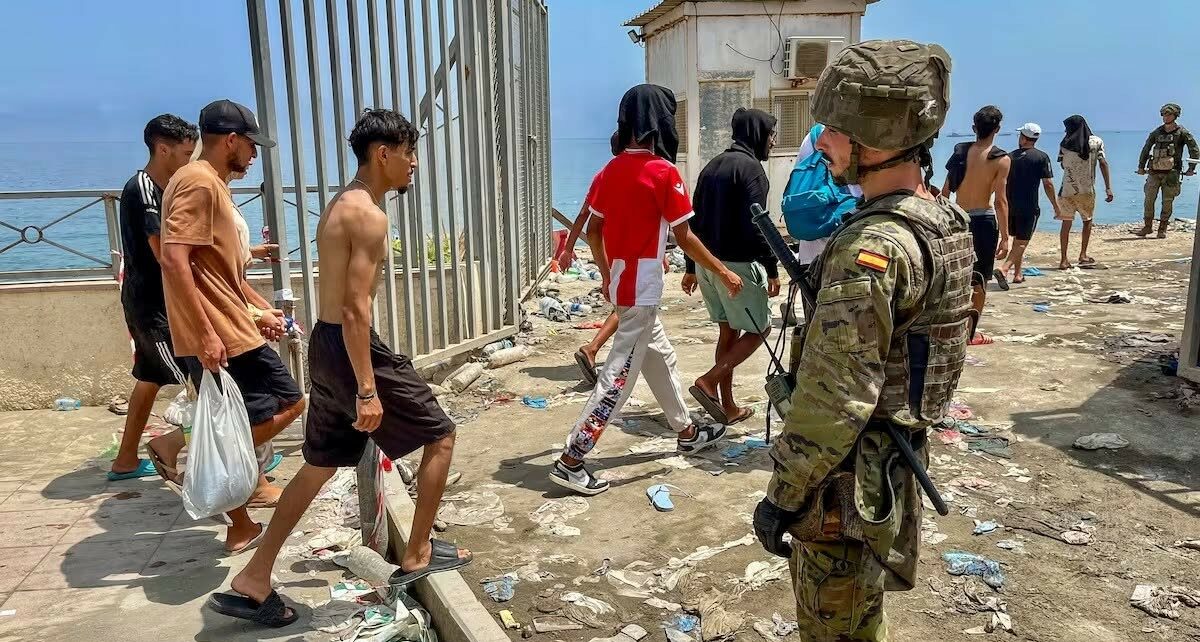
The bulk majority of the near 60,000 migrants- mostly young Moroccans- who crossed into the Spanish-held enclave of Ceuta this week have streamed back home. Their hopes of a better life in Europe were crushed by hunger, hostility, violence and the harsh realization that conditions on the other side of the colonial barrier were worse than those they left behind.
According to Spanish authorities, within days tens of thousands returned after a mass crossing to Ceuta, telling stories of horror within the Spanish-occupied enclave.
Reuters reported that returnees repeatedly cited empty stomachs, closed shops, exhaustion and open hostility from locals.
Many described Ceuta as “like a prison.” Shops and supermarkets remained shuttered, leaving the arriving migrants searching the streets for food and water while their wet clothes dried in the open.
One young man from Fez told Reuters he survived three days on water alone after finding a tuna sandwich priced at the equivalent of more than 100 Moroccan dirhams.
Others said they could not even find bread. Accounts of bad treatment circulated widely among returnees and in Moroccan media as well.
Some young men reported being chased, hit or driven out of neighborhoods, including the predominantly Moroccan-origin district of El Principe.
While Spanish authorities recorded limited incidents of knife attacks, the broader atmosphere of rejection and the deliberate closure of commercial life sent a clear message that the newcomers were not welcome.
For many, the dream sold on social media of easy passage to mainland Spain evaporated the moment they faced closed doors, empty streets and visible resentment.
After witnessing the reality inside the enclave – no work, no food, no onward route, they returned of their own accord, walking back across the border or taking taxis from Fnideq, the Moroccan town facing Ceuta.
Their voluntary mass return undercuts any narrative of irreversible “invasion” and instead highlights the human cost of Spain’s colonial foothold, a fortified European outpost on Moroccan soil that offers neither opportunity nor dignity to those who reach it.
The episode has reinforced a simple truth for many of the returnees. The artificial barrier that separates them from what is geographically and historically Moroccan territory delivers not European prosperity but hunger, rejection, racism, abuse and violence.