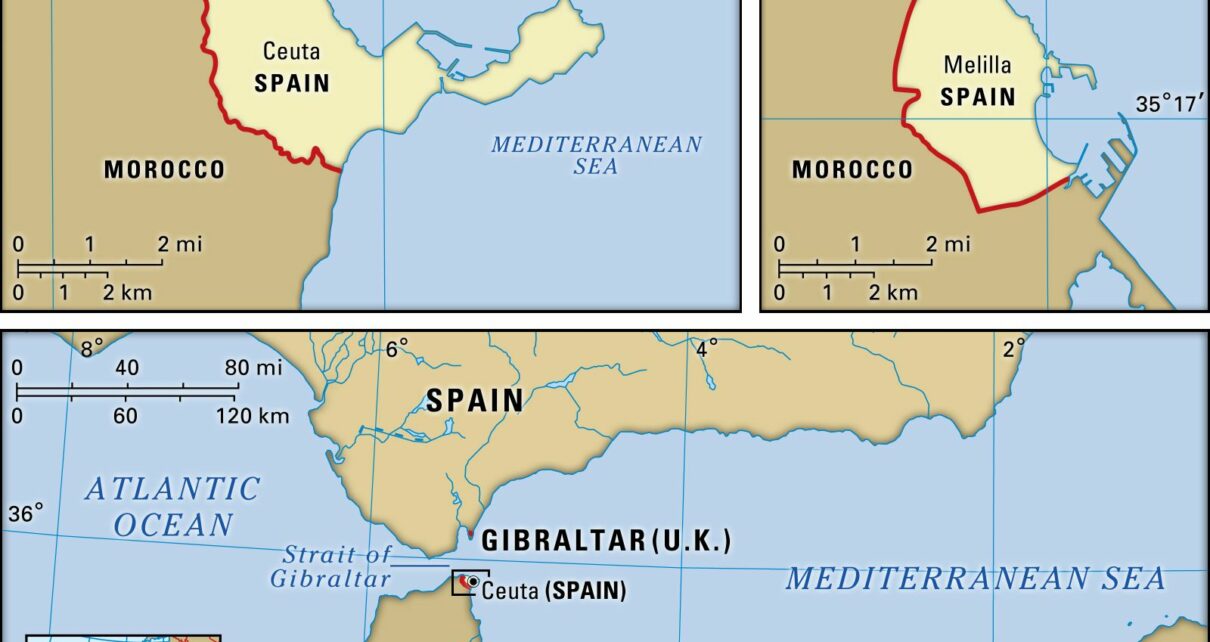
This week’s mass crossings into the Spanish-held enclave of Ceuta have exposed an enduring colonial reality often ignored in mainstream media. Spain continues to occupy Moroccan soil, denying Moroccans free movement on their own territory and enforcing artificial barriers that generate human tragedies like the one that has unfolded this week.
Between Thursday and Friday, an estimated 50,000 to 60,000 people entered Ceuta from Morocco by land and sea.
At least 67 died, many drowning while swimming around Spanish barriers. Spanish troops were deployed, a floating sea barrier ordered, and Prime Minister Pedro Sánchez denounced the influx as a “violation of Spain’s territorial integrity.”
The bulk of arrivals soon returned to Morocco after their dreams of a better life were shattered on the rock of hunger and violence by Ceuta locals.
Yet the episode underscores a deeper injustice. Ceuta and the other enclave of Melilla are not vague “North African” territories, as Spanish officials prefer to frame them. They lie in Morocco adjacent to Moroccan towns, in unbroken geographical continuity. Calling them North African is a deliberate dilution designed to obscure their specific Moroccan character and Spain’s colonial hold.
The natural order is freedom of movement for Moroccans across their own soil. Spain’s fortifications turn that right into a lethal obstacle.
Spain cannot justify permanent control by citing centuries of occupation. Such logic would equally allow Morocco to claim Al-Andalus, ruled for over 800 years by Moroccan dynasties.
Demographically, large majorities of residents in both enclaves are of Moroccan origin, bound by family, language, culture and religion to the surrounding population.
Maintaining European sovereignty over territories whose people are overwhelmingly Moroccan only entrenches division. Spain’s lectures to Israel on occupation ring particularly hollow. A state that itself holds two fortified enclaves inside Morocco has no moral standing to criticize others over disputed territories.
Western silence on these Moroccan cities – never placed on the UN list of Non-Self-Governing Territories – only deepens the double standard. As long as Spain clings to these colonial remnants, migration crises, human costs and political friction will persist.
Ending the occupation of Moroccan soil is the only path to genuine stability.