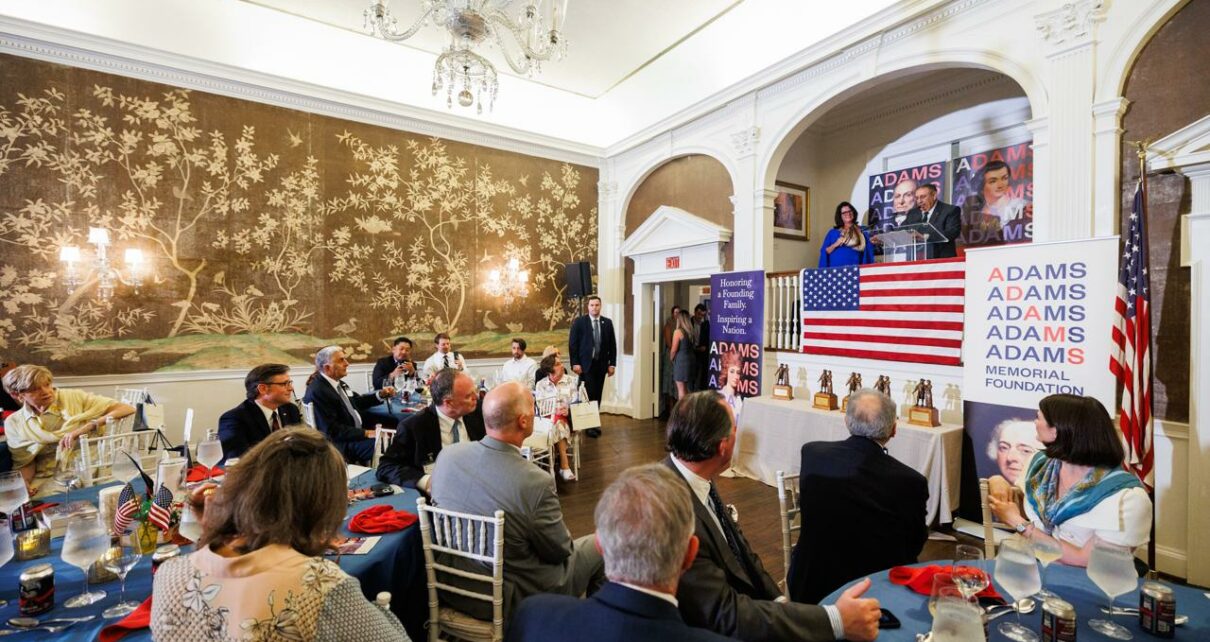
A gathering held recently in Washington brought together senior figures from American political life to celebrate the longstanding friendship between Morocco and the United States, timed to coincide with the 250th anniversary of American independence. The event was organized by the Adams Memorial Foundation, a body dedicated to preserving the legacy of John Adams, the second president of the United States and one of the signatories of the 1786 Treaty of Peace and Friendship with the Kingdom of Morocco.
House Speaker Mike Johnson attended alongside Congressmen Bill Keating of Massachusetts, John Moolenaar of Michigan, Stephen Lynch of Massachusetts, and Morgan Griffith of Virginia, underlining the bipartisan weight given to the occasion. Foundation president Jackie Gingrich Cushman used the gathering to highlight what she described as an enduring friendship stretching back to the earliest days of American nationhood, calling it one of the most remarkable chapters in the country’s diplomatic history.
She recalled that Morocco, under Sultan Sidi Mohammed Ben Abdallah, became the first nation in the world to recognize American independence in 1777. A few years later, American diplomats John Adams and Thomas Jefferson negotiated and signed the Treaty of Peace and Friendship with Morocco, which remains the oldest unbroken treaty in United States history still in force today. Cushman said the agreement, in which Adams played a direct and decisive role, helped secure American trade routes and protect its ships and sailors as the young republic sought to establish itself internationally.
Morocco’s ambassador to Washington, Youssef Amrani, echoed that sentiment, pointing to the relationship’s unmatched potential for growth and deepening cooperation. He noted that despite political transitions, geopolitical disruptions, and shifts in the global order over more than two centuries, the Moroccan-American partnership has continued to strengthen, with trust as its foundation.
Amrani added that under the leadership of King Mohammed VI, and with the engagement of President Donald Trump, the bilateral relationship is now entering a new phase of strategic acceleration, with political, security, economic, and technological interests converging more closely than ever before. The value of an alliance, he said, is measured by its actions rather than its rhetoric.