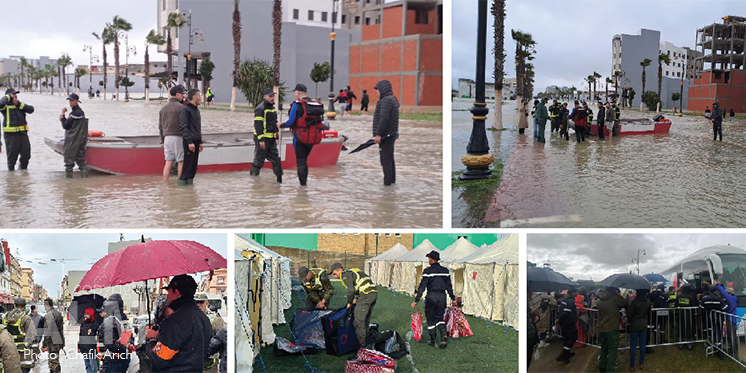
Moroccan authorities have evacuated more than 154,000 people from flood-affected or threatened areas across northern Morocco and the Gharb region as hydrological conditions risk deteriorating further, increasing danger levels. The Interior Ministry reported Friday that proactive evacuation operations continue considering severity and potential damage scope.
Evacuation figures reached 112,695 in Larache province, 23,174 in Kenitra, 14,079 in Sidi Kacem, and 4,361 in Sidi Slimane. The vast majority of Ksar El Kebir residents evacuated within adopted preventive measures. Field data and observation forecasts indicate persistent flooding with worsening hydrological situations, prompting authorities to urge extreme vigilance while avoiding return to affected zones pending improved conditions and official directives.
The Education Ministry announced urgent measures guaranteeing educational continuity in weather-affected establishments. Regional Education and Training Academies, provincial directorates, and schools received instructions implementing necessary pedagogical and organizational arrangements coordinating with relevant stakeholders for learning continuity and exceptional situation management.
Schools near displaced families’ residences or accommodation sites welcome affected students, temporarily integrating them into classes corresponding to academic levels until conditions improve and return to original establishments becomes possible. Boarding and meals are provided when feasible. Concerned academies and provincial directorates established mobile learning spaces within temporary accommodation centers for students and preschoolers, equipped with necessary logistical and IT equipment.
Distance learning classes operate through coordination with certified “E-Qissmi” program teachers and volunteers. Digital educational resources and filmed lessons structured according to official programs by subject and level are available on the TelmidTICE platform and mobile application. Direct parent communication operates via Massar, reinforced by helpline-accessible monitoring cells.
In Taounate province, 700 actions and interventions since heavy precipitation onset aided 230 families representing 901 people following housing collapse or flood risks. More than 345 road interventions addressed 282 road sections, while over 40 liquid sanitation interventions occurred during the precipitation period.