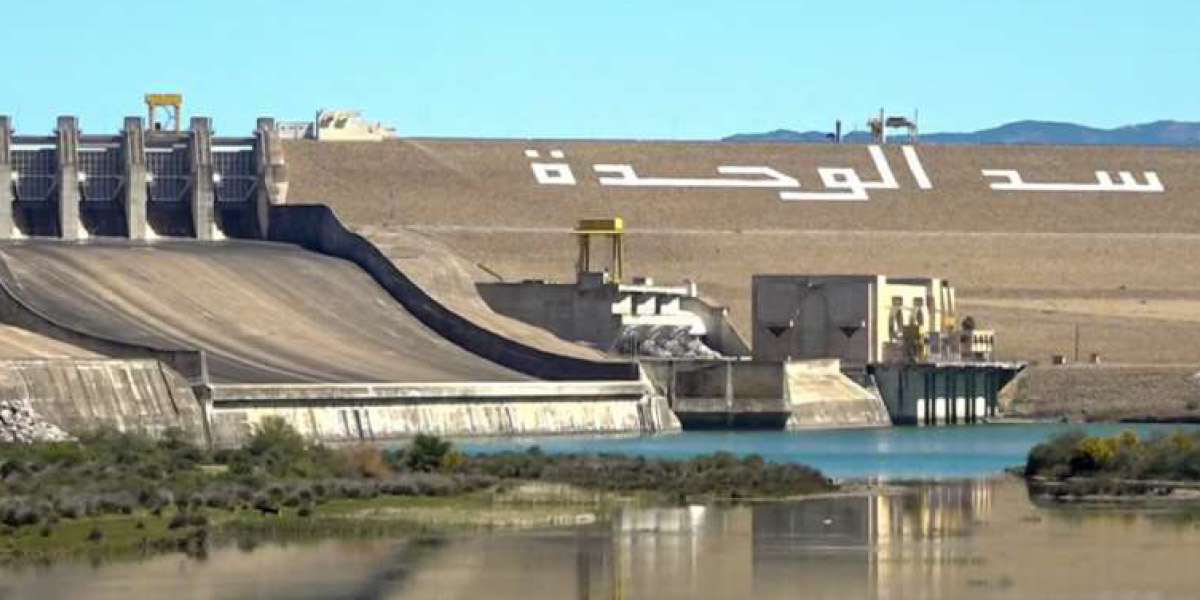
After an extended period marked by concerning water level declines, Al Wahda Dam, Morocco’s largest reservoir, is progressively recovering thanks to significant recent precipitation. These rains delivered nearly 600 million cubic meters of water inflows, bringing total stored volume to over 2.069 billion cubic meters—a 59.16% fill rate.
Precipitation exceeding 295 millimeters played a decisive role in this improvement. The recovery holds strategic importance as Al Wahda Dam constitutes a central element of the national water infrastructure, serving multiple critical functions including flood protection, agricultural irrigation, energy production, and drinking water supply.
Located in Taounate province on the Ouergha River, the main tributary of the Sebou River, this reservoir holds continental significance. According to Al Wahda Dam Director Mustapha Tantaoui, it ranks as Africa’s third-largest dam, following Ethiopia’s Renaissance Dam and Egypt’s Aswan High Dam.
With total capacity reaching approximately 3.522 billion cubic meters, Al Wahda is an embankment dam comprising a main dike and secondary dike, with combined length approaching 2,600 meters and wall height reaching 88 meters. Before recent precipitation, the dam’s situation was deemed “relatively uncomfortable,” posing serious resource management and usage continuity challenges. Rainfall recorded during December and early January, spanning several weeks, significantly alleviated these pressures.
The improvement extends beyond Al Wahda. Khalid El Ghomari, Director of the Sebou Hydraulic Basin Agency, reports the region received substantial precipitation since December 2025, totaling approximately 360 millimeters—a 32% increase compared to the previous year’s equivalent period.
These favorable climate conditions translated into marked water inflow improvements across basin reservoirs. Idriss I Dam displays stock nearing 510 million cubic meters, corresponding to approximately 45% fill rate. Other Taounate province hydraulic structures recorded encouraging levels, notably Bouhouda Dam at virtually full capacity (97%), Sahla Dam (48%), and Asfalou Dam (37%).
Globally, the Sebou basin currently totals over 6.64 billion cubic meters of stored water, representing a 55% fill rate against barely 40% last December. Beneficial rainfall effects extend to groundwater tables, with notable level increases observed, particularly nearly two meters in the Saiss plain.