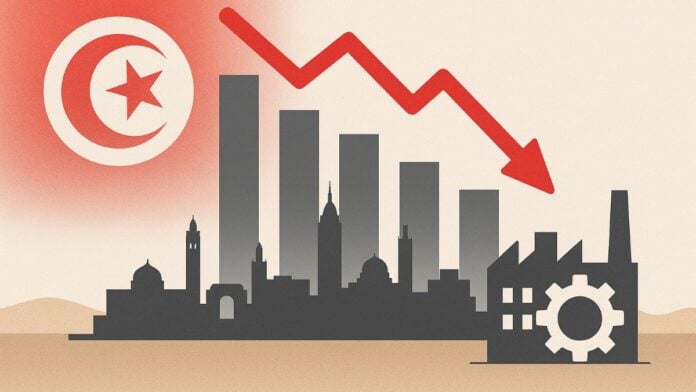
Tunisia’s economic credibility is eroding rapidly, with the country now absent from key international benchmarking reports and struggling to attract foreign investment.
Once hailed by the World Bank as a model of sound governance in Africa and the Middle East, Tunisia has become a cautionary tale of missed opportunities, political drift, and economic mismanagement in a political context marked by backpedaling to autocracy and populism.
The country no longer features in the World Bank’s Business Ready index or Ernst & Young’s Africa Attractiveness Report, signaling a sharp decline in its visibility among global investors.
The economic consequences of Tunisia’s drift to dictatorship under Kais Saied have been severe. According to recent IMF Article IV consultations, Tunisia’s GDP growth is the weakest in North Africa, projected at just 1.4% in 2025, far behind Libya (up to 8.4%), Egypt (4.5%), Morocco (4.4%), and Algeria (3.5%).
Foreign and public investment have collapsed. Tunisia’s foreign debt, now at 75% of GDP, has become more precarious, with 36% maturing in less than a year and carrying high interest rates. Domestic debt is surging, crowding out private sector financing and stifling entrepreneurship. Inflation is forecast to reach 9.3% by 2030, triple the rate of neighboring countries.
Public spending is increasingly unsustainable. Over 80% of tax revenue is consumed by salaries and subsidies, leaving little room for infrastructure or innovation. The Central Bank has lost its independence, and official statistics are becoming scarce and unreliable.
Tunisia’s economic policy, critics say, is based on redistributing wealth that no longer exists. Populist measures have failed to address deep regional inequalities, the same disparities that fueled the 2010 uprising. With international credit markets closing their doors and domestic confidence waning, Tunisia faces a stark reality: the emperor has no economic clothes, and few are allowed to say so.