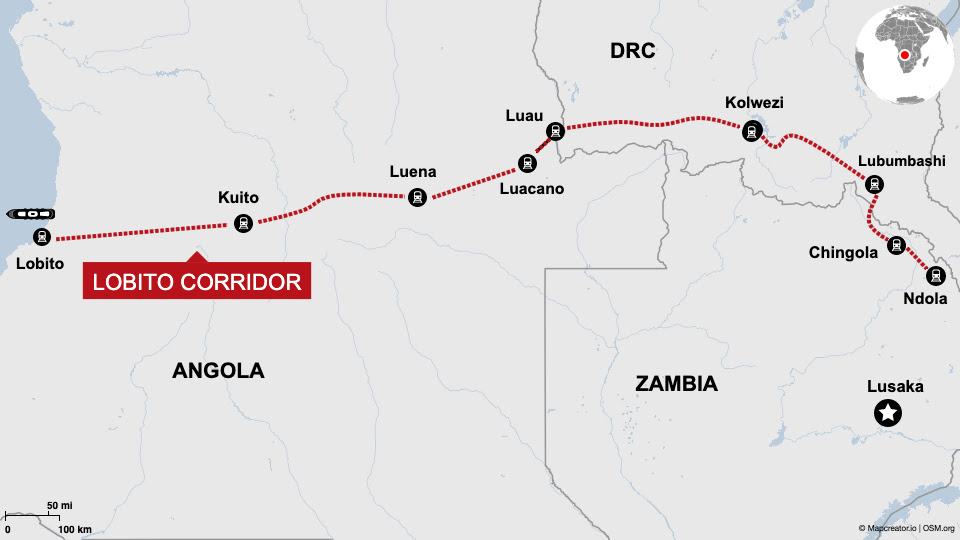
The Trump administration has reaffirmed its commitment to the $4 billion Lobito Corridor rail project in Africa, aiming to strengthen United States-Africa economic ties while countering China’s growing influence in the region.
The initiative, which connects Angola, Zambia, and the Democratic Republic of Congo (DRC), is seen as a vital trade route for transporting minerals like copper and cobalt — key resources for electric vehicle and technology industries. Despite rising global tariff tensions, the U.S. has pledged ongoing support for the project, originally introduced under president Joe Biden. U.S. chargé d’affaires James Story emphasized America’s dedication to the Lobito Corridor, signaling a shift in policy that prioritizes strategic infrastructure development in Africa. The rail project, which spans over 800 kilometers, is considered crucial for regional integration, improving access to Central Africa’s mineral-rich regions. The initiative is backed by international entities, including the U.S. International Development Finance Corporation (DFC), which has committed a $553 million loan.
Though the Trump administration has not fully embraced all aspects of Biden’s Africa strategy, such as its focus on agricultural development, it has shown interest in tapping into the continent’s mineral wealth. The project’s support comes amid growing competition with China, which has previously funded infrastructure projects in the region. A recent article in The New York Times highlighted some early indications of the Trump administration’s support for business investments in Africa. For example, Ben Black, the president’s nominee to run the U.S. International Development Finance Corporation has said he wants to take an “investment-driven” approach to overseas spending. Adam Cortese, CEO of Sun Africa, said that Trump officials have expressed a desire to invest in developing Africa’s energy infrastructure, adding that “there certainly seems to be a lot of support for increasing U.S. competition with China.”