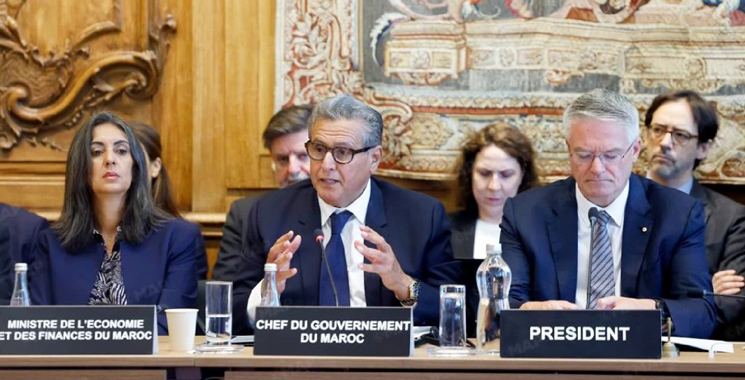
Head of Government Aziz Akhannouch presented Morocco’s recent macroeconomic and social achievements before the Council of the Organization for Economic Co-operation and Development (OECD) in Paris, stressing the Kingdom’s determination to become a stronger and more competitive economy and a pole of stability for its region, Africa and the broader euro-Atlantic space.
Akhannouch, accompanied by Economy and Finance Minister Nadia Fettah, linked the country’s progress to the leadership of King Mohammed VI, describing him as the guarantor of continuity in public policy.
Morocco had chosen to “stay the course” amid a difficult global environment marked by geopolitical tensions, worldwide inflation and the reconfiguration of value chains, he said, highlighting efforts to consolidate the social state, human capital, the productive apparatus and macroeconomic balances.
According to national accounts from the High Commission for Planning (HCP), GDP growth reached 4.9% in 2025, up from 4.4% in 2024.
After the global inflation peak, Morocco brought inflation down to 0.9% in 2024 and 0.8% in 2025.
The budget deficit stood at 3.5% of GDP in 2025. On the social front, Akhannouch highlighted what he called the historic generalization of social protection, monthly assistance to the most vulnerable families, the renovation of primary healthcare facilities and ongoing education reforms.
Since the entry into force of the new Investment Charter, 381 projects have been approved for a total of MAD 581 billion (approximately $58.1 billion).
These projects are expected to generate 245,000 direct and indirect jobs. The head of government singled out the automotive sector.
Akhannouch pointed to Morocco’s co-hosting of the 2030 FIFA World Cup with Spain and Portugal as more than a sporting event, arguing that the infrastructure being built “must first serve our citizens, our territories and our economy, well beyond 2030.