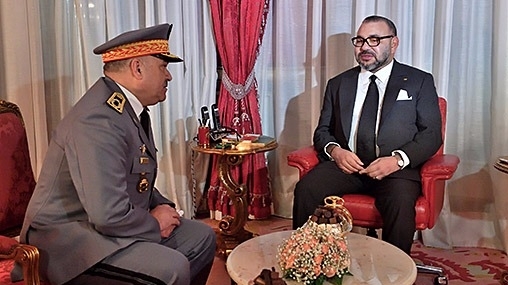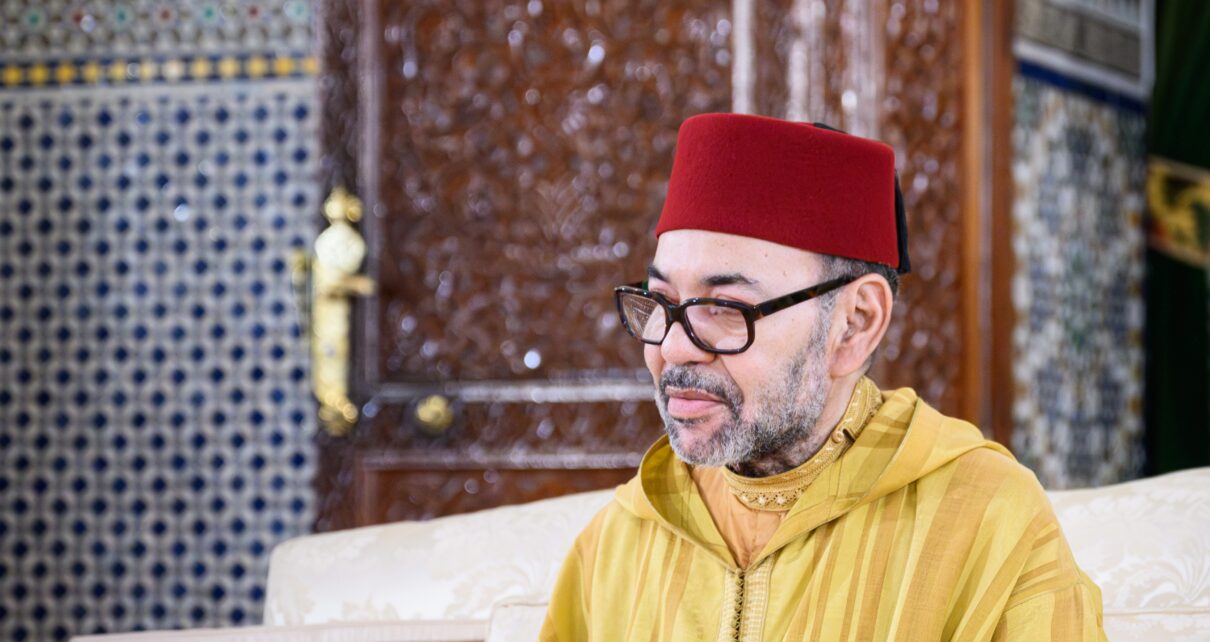
King Mohammed VI, Commander of the Faithful, accompanied by Crown Prince Moulay El Hassan, Prince Moulay Rachid and Prince Moulay Ahmed, chaired over a religious ceremony commemorating Eid Al Mawlid Annabawi.
This religious ceremony, held at the Royal Palace in Rabat on Monday, was marked by the recitation of verses from the Holy Quran and panegyrics of Prophet Mohammed (pbuh).
During the ceremony, Minister of Endowments and Islamic Affairs, Ahmed Toufiq, made an address in which he reviewed the activities of the Supreme Council of Ulema and local Ulema Councils.
In his address, the Minister said that the King, Commander of the Faithful, had, on the occasion of last year’s Eid Al-Mawlid Annabawi celebrations, tasked the Supreme Council of Ulema to undertake multiple actions to commemorate the anniversary of the fifteenth century of the birth of the Prophet.
He underlined that throughout the year, in line with the King’s guidelines, large gatherings were held where prayers were offered in honor of the Prophet and the noble virtues of the Seal of the Messengers were preached.
The Minister affirmed that the unwavering devotion shown by the Moroccan Nation to the Prophet is illustrated through two expressions rooted in religion, one of a political nature and the other of an emotional nature.
The political dimension, he explained, is reflected in perpetuating the legacy of the Commandery of the Faithful, of which the descendants of the Prophet are the custodians, while the emotional dimension is reflected in Moroccans’ emphasis on the lofty virtues of the Messenger of God, as expressed in the works of two Moroccan scholars from the city of Sebta, namely Cadi Ayad (“Treatise on the Healing Virtues of Knowledge of the Prophet’s Rights”) and Abu Abbas Al-Ozfi (“Anthology of Poems Composed in Celebration of the Birth of the Illustrious Prophet”), in addition to Imam Jazouli’s work “Guides to the Paths of Goodness,” whose prayers Moroccans skillfully invoked in their sacred struggle to liberate the occupied cities along the Atlantic Ocean at the dawn of the modern era.
The Minister then said that the Moroccan Nation, which has naturally sought refuge in the guidance of the Prophet through obedience as a testament to its love for the Seal of the Messengers, attests today that its ulema and scholars, deeply aware of the essence of the words of the Prophet Sidna Mohammed, peace and blessings be upon Him, are working, as part of the “Tassdid Tabligh” communication plan, to convince people, with the greatest clarity and simplicity, that the monotheism upon which the Holy Quran and the Prophet’s mission are based is exemplified by moral liberation from selfishness—both individual and collective—a liberation fostering a concrete reform of religiosity.
The Minister of Endowments and Islamic Affairs then presented the Sovereign with the Arabic-language book “Dakhirat Al Muhtaj Fi Assalati Ala Sahibi Alliwae Wa Taj,” published by the Ministry of Endowments and Islamic Affairs, which draws upon dozens of manuscripts safeguarded in royal, public, and private libraries in Morocco and abroad.
This publication comes following the guidelines issued by the King, who had called, last year, in a Letter addressed to the Supreme Council of Ulema, for the commemoration of the 15th century since the birth of the Prophet Sidna Mohammed, may prayers and peace be upon Him, notably through the publication of books and works from Morocco’s cultural heritage on prayers for the Prophet and the works of Moroccan ulema and scholars on this subject.
The celebration of this religious evening by King Mohammed VI is in line with the tradition observed by his illustrious ancestors who have constantly taken care to commemorate the anniversary of the coming to the World of the Messenger of Mercy, Their Ancestor the Prophet Sidna Mohammed, may Peace and Prayer be upon Him.
An anniversary that marks the blossoming of the lights of guidance for Humanity, thanks to the message carried by the Seal of the Prophets, to spread the high virtues and values of justice and recommend good deeds so that all humans live in peace and understanding.