“Morocco has successfully invested in young talent, modern infrastructure, training centers, and facilities that meet international standards, such as the Mohammed VI Football Academy. The results on the field clearly show that this model works,” Morocco’s ambassador to Washington Youssef Amrani.
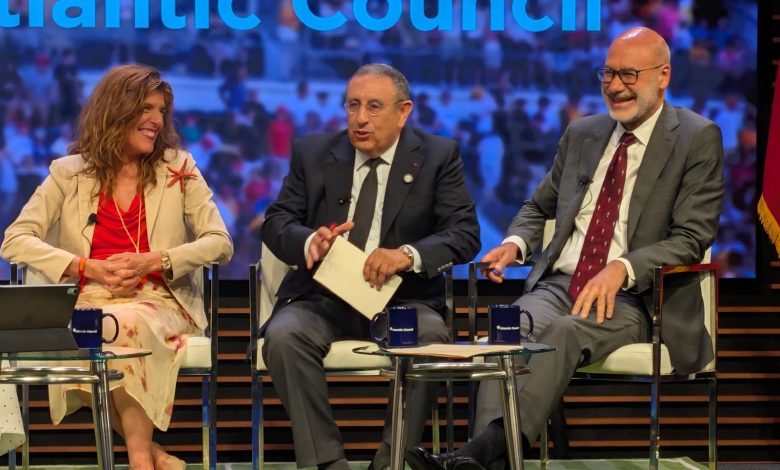
The remarks were made during a panel discussion organized by the American think tank Atlantic Council under the theme “Passing the Torch: Building the Legacy of the World Cup.”
Speaking about Morocco’s co-hosting of the 2030 FIFA World Cup, the diplomat emphasized that the global sporting event will give Morocco the opportunity to showcase to the world what it has achieved and what it is capable of as a stable country, a trusted partner, and a natural bridge between Africa and Europe.
“We want the 2030 World Cup to be a tremendous success for Morocco, for our partners in Spain and Portugal, for Africa and Europe, and for the entire football community,” Amrani said during the event, which was attended by the ambassadors of Portugal and Spain to Washington, as well as German international footballer and philanthropist Antonio Rüdiger, president of the foundation bearing his name.
“We are ready to make the 2030 World Cup a historic success,” he assured participants at the conference, which was organized by the Atlantic Council’s Africa Center.
He added that the 2030 World Cup also represents a unique opportunity to highlight African talent, innovation, creativity, and ambition.
“The World Cup is not just a sporting event. It is also a national development project and a powerful economic driver,” the diplomat stressed.
For Morocco, he explained, the expected benefits will be enormous for its youth, its people, and the nation as a whole, with accelerated investment anticipated in infrastructure, transportation, and other public sectors and services.
Referring to the Atlas Lions’ “highly commendable” campaign at the 2026 World Cup, the Moroccan diplomat said the national team leaves the tournament with great pride.
Beyond the results, he noted, the tournament enabled Morocco to discover new talent, develop a new style of play, and demonstrate an extraordinary level of passion, commitment, and team spirit. The national team, he added, presented a positive image of Morocco to the world.
This team embodied the values that define modern Morocco—ambition, resilience, discipline, and unity. It also reflected the long-term vision of King Mohammed VI, which is centered on investing in youth, talent, and human development, Amrani said.
He also congratulated the U.S. and Mexican authorities, as well as the various host cities, for helping make the tournament such an extraordinary success.
“The warm hospitality, the professionalism of the organization, and the passion for football demonstrated by everyone in the United States will remain etched in our memories for a long time,” he stated further.
Speaking via video-conference, Andrew Giuliani, Executive Director of the White House Task Force on the 2026 FIFA World Cup, said that in just a few days the World Cup torch would be passed to Morocco, Portugal, and Spain in a spirit of friendship, confidence, and great enthusiasm for what lies ahead.
He noted that the three countries would have the opportunity to leave their own mark on the FIFA World Cup, just as the United States, Mexico, and Canada did with the 2026 edition.
For her part, Spain’s Ambassador to Washington, Ángeles Moreno Bau, emphasized that co-hosting the 2030 FIFA World Cup would provide a major opportunity for Spain to further strengthen its relations and exchanges with Morocco and Portugal at all levels. She also praised the excellence and quality of the ties among the three countries.
Meanwhile, Portugal’s Ambassador to the United States, Francisco Duarte Lopes, said that the three co-hosting nations are fully prepared to stage the 2030 FIFA World Cup, which he said promises to be another outstanding success.