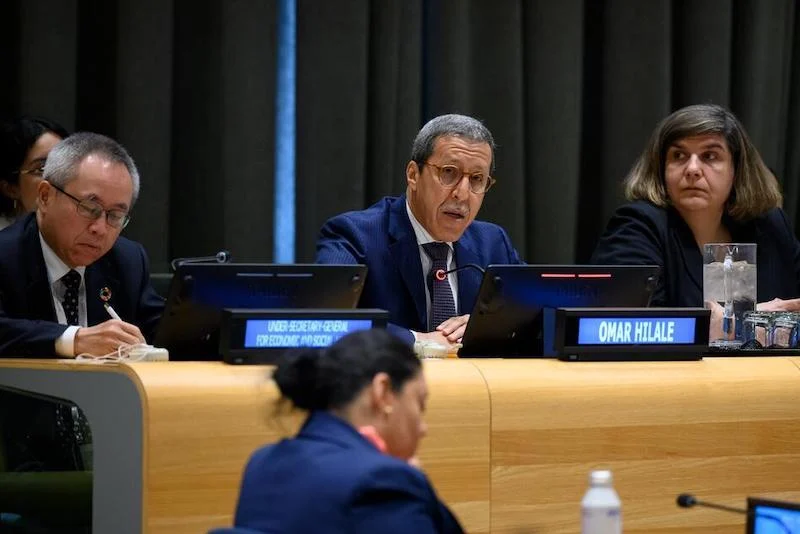
Morocco’s Permanent Representative to the United Nations, Omar Hilale, used Tuesday’s ordinary session of the UN Committee of 24 (C24) in New York to deliver a forceful restatement of Morocco’s position on its southern provinces, describing Security Council Resolution 2797, adopted on 31 October 2025, as a watershed moment that definitively frames the parameters for any settlement.
Addressing the C24 — whose June 15–26 session continues to include the Western Sahara on its agenda — Hilale argued that the committee was operating outside its legal remit. He cited Article 12 of the UN Charter, which assigns the Security Council sole authority over the question since 1991, and challenged the C24’s continued examination of a matter he characterized as entirely governed by Chapter VI of the Charter, which concerns the peaceful settlement of disputes rather than decolonization.
In Hilale’s reading, Resolution 2797 is not merely procedural. It cements Morocco’s autonomy plan under Moroccan sovereignty as the exclusive basis for a final settlement, formally sets aside the Polisario’s rival proposal, confirms the irreversible abandonment of the referendum option, and identifies four parties — Morocco, Algeria, Mauritania and the Polisario — as bearing joint responsibility for advancing the political process.
Three rounds of negotiations have already taken place, with parties having received Morocco’s detailed autonomy project and committed to submitting written responses.
Hilale also challenged what he termed the C24’s anachronistic framing, noting that the decolonization of the Sahara concluded in 1975 with Morocco’s recovery of the territory following the Green March, as confirmed by the Madrid Agreement. He pointed to tangible development indicators in the southern provinces: over 87 billion dirhams invested through the socioeconomic development program, backing from more than 130 UN member states for the autonomy plan, and more than 30 foreign consulates now operating in the region.
Characterizing the real obstacle as the other parties’ reluctance to engage their stated responsibilities, Hilale warned that the international community would hold them accountable for any further delay in what he described as a process whose framework, parameters and participants are now fully established.