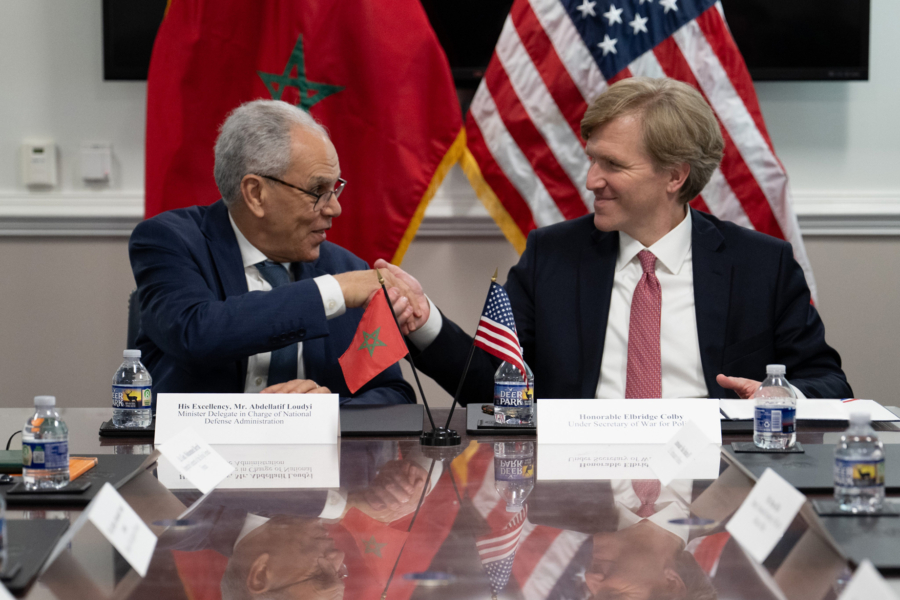
Morocco and the United States have formalized a new framework for bilateral military cooperation, by the signing of the U.S.-Morocco Defense Cooperation Roadmap at the Pentagon during a meeting between Under Secretary of War Elbridge Colby and a Moroccan delegation led by Minister Delegate for National Defense Administration Abdellatif Loudiyi and General Mohammed Berrid, Inspector General of the Royal Armed Forces. The document is designed to structure the two countries’ Defense partnership across the next decade, building on a relationship Colby described as grounded in 250 years of history — dating to Morocco’s recognition of the United States as its first international partner.
The roadmap, signed during the 14th meeting of the Morocco-U.S. Defense Consultative Committee, codifies a partnership that has already grown considerably in operational depth. For the Royal Armed Forces, the alliance provides access to advanced American military platforms, training at US military academies, and privileged knowledge transfer in intelligence and counterterrorism. For Washington, Morocco offers a strategically positioned anchor point at the gateway to Africa, a reliable, tested partner in a region of growing geopolitical competition.
The signing comes weeks before African Lion 2026, the annual bilateral exercise scheduled from April 20 to May 8 across five Moroccan sites: Agadir, Tan-Tan, Taroudant, Kénitra and Benguerir. This year’s edition carries particular symbolic weight, coinciding with the 250th anniversary of the United States. Staff from more than 40 American technology companies will join the military personnel on the ground to validate next-generation combat tools, making Moroccan territory a live testing environment for tactical artificial intelligence systems, advanced command architectures and deep-strike capabilities.
A notable technical milestone has already been achieved in the run-up. On February 3 in Agadir, the Royal Armed Forces and US forces tested the Link-16 tactical communication system — a secure, real-time data-sharing technology for land, air and naval units that until recently had been reserved exclusively for NATO member states. Morocco’s access to this system underscores the depth of interoperability that the two partners have achieved and the degree to which Rabat is being integrated into advanced Western Defense networks.
Together, the roadmap signing and the African Lion exercise frame Morocco’s military posture in 2026 as one of deliberate and accelerating strategic alignment with the United States. The Kingdom continues to diversify its Defense relationships — acquiring Apache AH-64E attack helicopters, pursuing next-generation observation satellites, and hosting the continent’s first drone operator training center for African armies — but the Pentagon roadmap makes clear that Washington remains the anchor of this expanding security architecture.
During their visit to Washington to take part in the 14th meeting of the Morocco-U.S. Defense Consultative Committee, Abdeltif Loudyi and Lieutenant General Mohammed Berrid were received by Pete Hegseth, US Secretary of War.

The meeting was marked by in-depth discussion on the enhancement of bilateral relations, mainly in the fields of defense, the arms industry, and cybersecurity.
Both parties commended the historic and exemplary relations that underpin the robust, historic alliance between Morocco and the United States.
The Moroccan military delegation’s visit also provided an opportunity for the Moroccan side to welcome the American position supporting the Kingdom’s full and complete sovereignty over its Sahara, and to highlight Morocco’s sustained efforts, as a committed actor for regional peace and security, to promote stability and prosperity at both the regional and international levels.
The 14th meeting of the defense consultative Committee was held in Washington April 14-16.