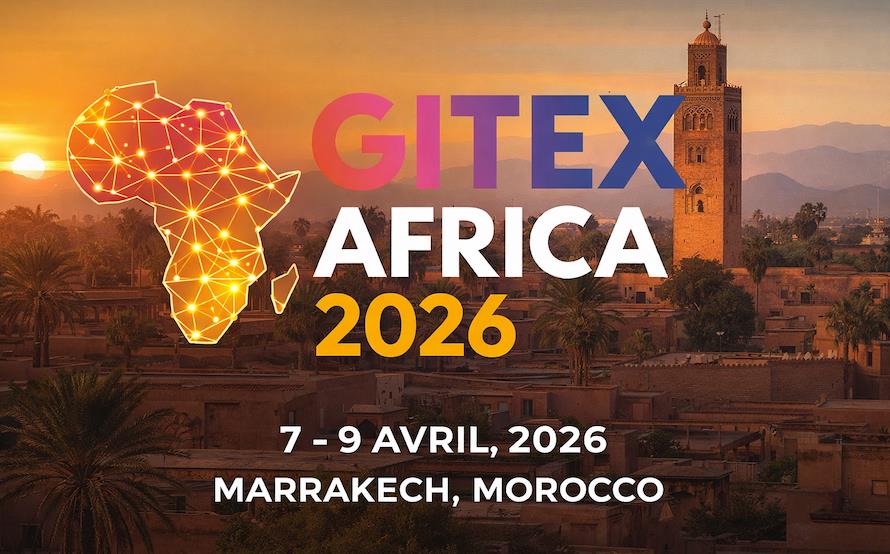
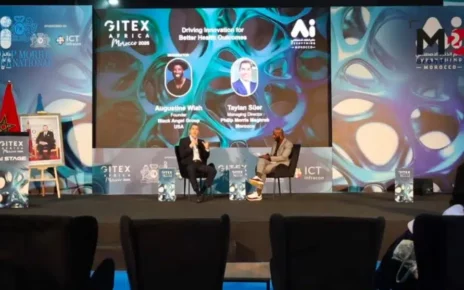
The fourth edition of GITEX Africa Morocco opened Tuesday April 7 in Marrakech with a clear message from the Kingdom’s leadership: Morocco is ready to be Africa’s technology gateway. Prime Minister Aziz Akhannouch inaugurated the event, which this year drew 50,000 participants and over 1,450 exhibitors from 130 countries, making Marrakech one of the most significant innovation platforms on the continent. The event is jointly organized by the Ministry of Digital Transition and Administrative Reform, the Digital Development Agency and KAOUN International, a subsidiary of the Dubai World Trade Centre.
Akhannouch used his opening address to send an unambiguous signal to international technology investors. Morocco, he argued, offers the combination of institutional stability, clear political direction, a skilled human capital base and modern infrastructure that high-value digital investments require. He also contextualized GITEX Africa’s broader ambition: to give the continent a platform for self-expression and to connect Africa’s energy and youth with the financial, training and market infrastructure needed to convert potential into growth.
The strategic foundation underpinning these ambitions is the Maroc Digital 2030 national strategy, which reorganizes previously fragmented initiatives into a coherent, government-wide roadmap. Its two pillars — a digital state and a digital economy — have already produced measurable results. Between 2021 and 2024, the digital investment budget rose from 11 million to 1.7 billion dirhams. By end-2024, the offshoring and digital exports sector had generated 148,500 jobs and exceeded 26 billion dirhams in services exports. Targets for 2030 stand at 270,000 jobs and 40 billion dirhams in exports.
Artificial intelligence occupies a pivotal place in Morocco’s digital roadmap. Following the Royal strategic orientation toward technological sovereignty, Morocco advanced 14 places in the 2025 Government AI Readiness Index.
Minister Amal El Fallah Seghrouchni articulated Morocco’s ambition as a ‘third way’ — neither a technological heavyweight seeking domination, nor a passive adopter — but a country capable of harnessing AI to serve its citizens, bridge Europe and Africa, and act as a balancing power in the shifting global digital order. Concrete initiatives include the Jazari Root Institute and the AI Made in Morocco program.
Infrastructure upgrades reinforce these ambitions. The commercial rollout of 5G is under way, with 45 percent population coverage targeted by end-2026 and 85 percent by 2030. Fixed high-speed internet subscriptions passed 1.4 million fibre connections by end-2025, and a program is targeting 1,800 rural communes to eliminate coverage gaps. A global cloud provider has already established data centers and an R&D facility in Casablanca, generating over 700 skilled jobs — an early sign that Morocco’s pitch to international technology investors is beginning to yield tangible results.