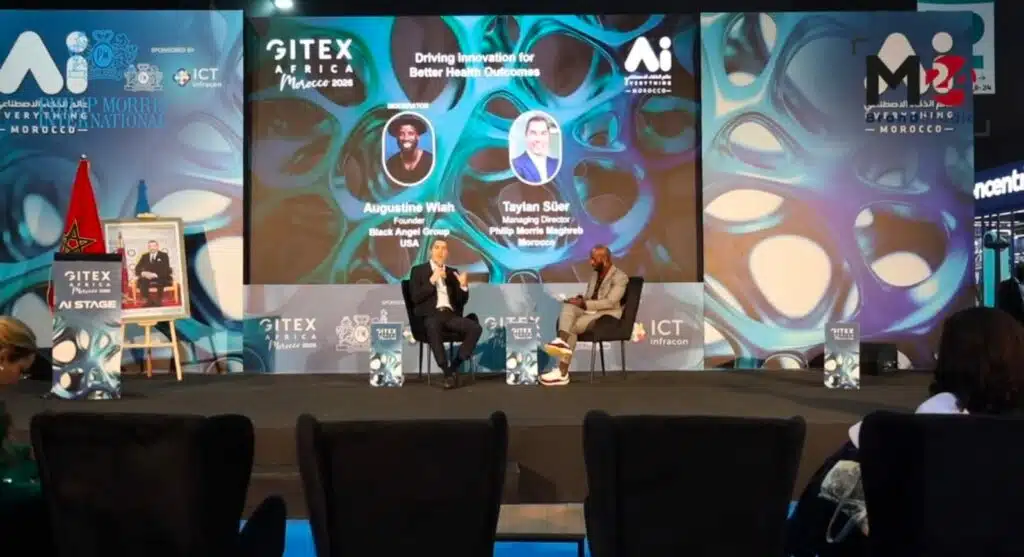
Philip Morris International (PMI) used its participation in GITEX Africa 2026 to advance a vision of healthcare transformation premised not on technological novelty, but on measurable outcomes at scale. Speaking at a panel on stimulating innovation for better health results, Taylan Süer, Managing Director of Philip Morris Maghreb, argued that the central challenge of health innovation today is not creating new solutions but designing systems capable of translating scientific advances into population-level impact — rapidly and equitably.
Süer highlighted a structural tension that he described as one of the defining paradoxes of modern healthcare: innovation tends to widen inequalities before it narrows them, because access, affordability and infrastructure lag behind discovery. In his view, the true measure of successful innovation is how quickly it can reach the populations most in need — and that requires not just science, but intelligent regulation and effective adoption frameworks. He called for deepened collaboration between public institutions, regulators and the private sector as the only way to close that gap at pace.
PMI’s own strategic transformation served as the practical backdrop for these arguments. The company has invested over 16 billion dollars in smoke-free product development, and those products now account for more than 40 percent of its global revenues. Süer presented this as evidence that science-led innovation, when coupled with coherent policy engagement, can drive real behavioral change: 43 million adult smokers have transitioned away from cigarettes using PMI’s alternative products. The company’s framework rests on three levers — prevention, cessation support and risk reduction through combustion-free nicotine alternatives.
Artificial intelligence featured prominently in Süer’s account of PMI’s operational evolution. He described AI as a force multiplier across the healthcare value chain, accelerating drug discovery, optimizing clinical trial design, enabling AI-assisted diagnostics and personalizing behavioral interventions. Within PMI, AI is being deployed to build a centralized scientific management system that aggregates all research data, protocols and historical results, substantially reducing preparation timelines and enabling faster, more rigorous decision-making across scientific programs.
On Africa specifically, Süer identified a rare opportunity for the continent to bypass incremental improvement and adopt transformative health architectures from the outset — digital-first health delivery, AI-assisted diagnostics and smarter regulatory frameworks built for innovation rather than against it. Morocco, he suggested, is already laying the groundwork for this transition, combining institutional openness, constructive policy dialogue and a pragmatic approach to public-private partnership that positions it as a credible model for the broader African health innovation agenda.