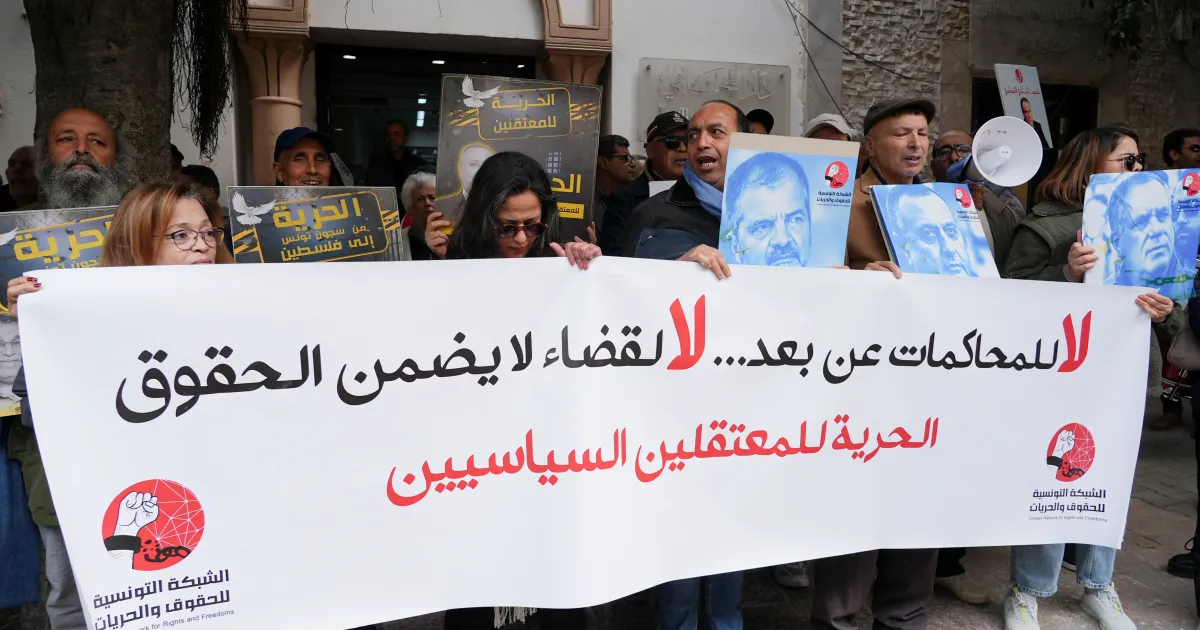
Human Rights Watch has denounced the harsh and unfair sentences issued lately by a Tunisian court against political opponents of the authoritarian regime of Kais Saeid.
Prison sentences of up to 66 years were handed down to 37 politicians, businessmen, and lawyers in politically-motivated sham trials, said HRW, decrying quash unfair proceedings.
The Tunis Court of First Instance issued the sentences after just three sessions in the mass trial, without providing the defendants with an adequate opportunity to present their defenses and without other due process protections, the Human rights Watchdog.
The defendants were accused of plotting to overthrow President Kais Saied by destabilizing the country, and even of plotting to assassinate him. Businessman Kamel Ltaif received the longest sentence of 66 years on, while opposition politician Khayam Turki was given a 48-year jail term.
The court also sentenced prominent opposition figures, including Ghazi Chaouachi, Issam Chebbi, Jawahar Ben Mbarek and Ridha Belhaj, to 18 years in prison. They have been in custody since 2023.
“The Tunisian court did not give defendants so much as a semblance of a fair trial, sentencing them to long terms after a mass trial in which they could not adequately present their case,” said Bassam Khawaja, HRW deputy director for MENA.
“The Tunisian authorities are making it clear that anyone participating in political opposition or civic activism risks years in prison after a hasty trial without due process”, said the HRW official
Abdelhamid Jelassi, a political activist and former Ennahda party member, and Said Ferjani, a former Ennahda parliament member, were sentenced to 13 years; and Lazhar Akremi, a lawyer and former minister, was sentenced to 8 years. The court sentenced another 15 defendants, including the exiled feminist activist Bochra Belhaj Hamida, to 28 years in prison.
The Tunisian authorities are using arbitrary detention and politically motivated prosecutions to intimidate, punish, and silence critics, Human Rights Watch said.
Following President Saied’s takeover of Tunisia’s state institutions on July 25, 2021, the authorities have dramatically intensified their repression of dissent.
Saied secured a second five-year term in 2024 with suspicious 90.7% of the vote amid low turnout after coming to power in 2019. Rights groups say he has had full control over the judiciary since he dissolved parliament in 2021 and began ruling by decree. He dissolved the independent supreme judicial council and sacked dozens of judges in 2022.
Afterwards, the authorities have stepped up arbitrary arrests and detention of people across the political spectrum who were perceived as critical of the government.
Tunisian authorities should overturn these convictions, guarantee fair trials, and stop prosecuting individuals for exercising their human rights, Human Rights Watch said. Tunisia’s international partners should break their silence and urge the government to end its crackdown and to protect space for freedom of expression, association, and peaceful assembly.