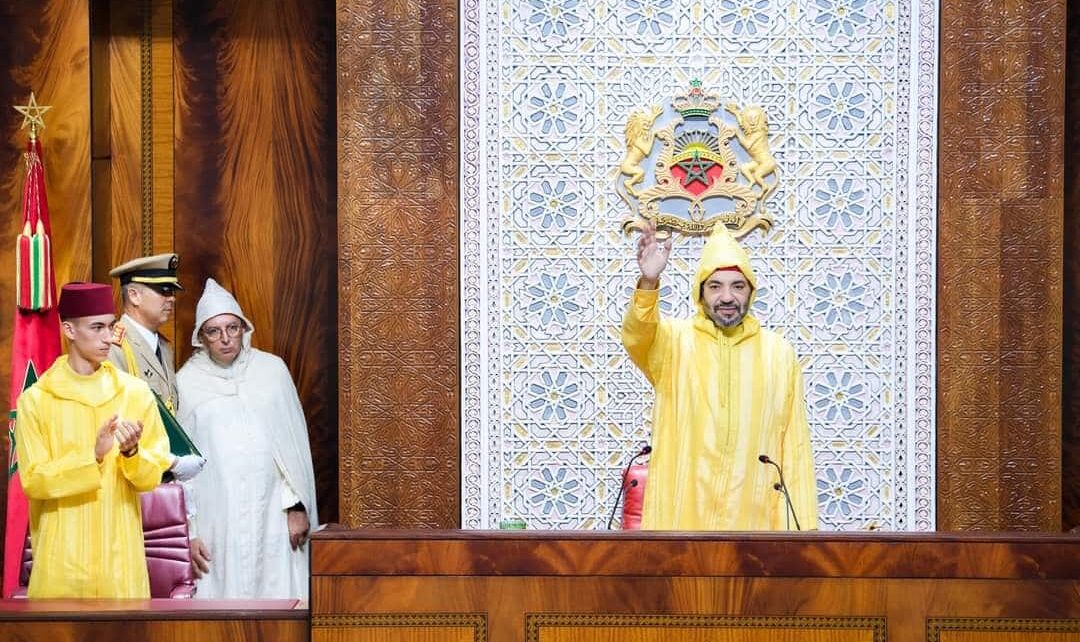
King Mohammed VI has affirmed that Morocco has succeeded in consolidating its international status as a responsible and reliable partner committed to fulfilling its obligations, stressing that the Kingdom expects the same commitment from its partners.
In a speech he delivered Friday before the two Chambers of Parliament at the opening of 1st Session of 1st Legislative Year of 12th Legislature, the King said the balanced approach adopted by Morocco in managing the migration phenomenon has produced tangible results.
“However, we must acknowledge, with all due courage and objectivity, that the current cooperation model in this area has become outdated. The recurring crises are a clear testimony to this”, added the King, noting that this applies to neighboring, Spain.
Morocco’s partnership with Spain “has witnessed significant developments in various sectors, including the fight against illegal migration”, underlined the Monarch.
However, “this cooperation is currently facing significant challenges stemming from some obsolete legal provisions and unrealistic judicial rulings. They are regrettably impeding the repatriation of minors and of fake asylum seekers, while fueling the greed of criminal networks”, said the King.
Regarding the irresponsible statements and the blatant exploitation of the issue by some political and media circles, the Moroccan Sovereign said “this partnership is a sovereign choice and a voluntary commitment. It will never be subject to any pressure, threat, or blackmail.”
Morocco will present a document to its partners setting out a clear and practical strategic vision that paves the way for a new direction which promotes shared development, economic competitiveness, and regional stability, said the Monarch.
In his speech to the Parliament, the King also spoke about the new generation of reforms and major projects launched to keep up with the rapidly accelerating geo-economic shifts.
Today, in addition to accelerating the implementation of planned infrastructure projects, “we must launch a new generation of major strategies, particularly in the fields of water, energy, and food security, industrial takeoff, the digital economy, and artificial intelligence”, said the King.
He reiterated his call to accelerate the development of the Kingdom’s capabilities in the field of strategic reserves and to secure the supply of basic commodities.
The King also urged the private sector to step up and become a strategic player in the country’s development transformation, stressing the importance of placing youth issues at the forefront of public policies and of the agenda of governance bodies.
The King called for a comprehensive vision guaranteeing equal opportunities and encompassing education, skills development, and economic integration. The goal is to bolster young people’s confidence in the prospects for social advancement, in their nation’s institutions, as well as in the opportunities provided to build a better future – one that guarantees freedom, dignity, and stability.
The real challenge for the coming period lies in fieldwork, at the local level, to identify the actual problems facing each region and come up with realistic solutions to them, said the King.
Advancing integrated development, improving public services, and bolstering productive investment are inextricably linked to the process of advanced regionalization and administrative de-concentration, underlined the Monarch.
However, the delays and deficiencies that continue to hinder the implementation of decentralization and administrative de-concentration are adversely affecting economic and social development programs and are impeding the response to citizens’ real concerns, said the King.
“I therefore wish to stress that any further delay or procrastination in the full implementation of the de-concentration charter is unacceptable”, stressed the King, making reference to the required transfer of competencies, and of the necessary human and financial resources, from the central government to the provinces and regions.
He also stressed the need to put an end to the obstacles that continue to hinder the work of regional institutions, particularly through a clearer definition of their competencies and the provision of greater human and material resources.
“Today, we need to regulate the relationship between the State and the Regions, and to establish mechanisms for coordination and contracting in order to enable the Regions to make decisions and implement projects,” said the King.