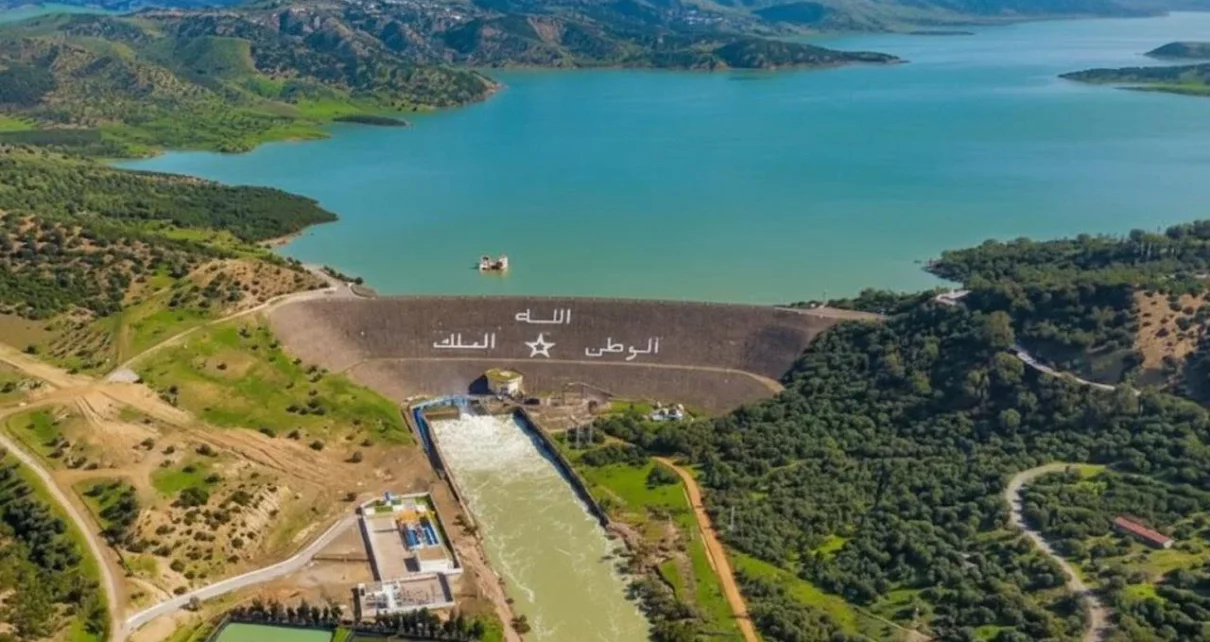
Morocco’s Ministry of Equipment and Water is launching a study of 10 major dams to measure sediment accumulated in their reservoirs and update their real storage capacity, following an exceptional rainy season that sharply raised fill levels at several facilities. The exercise, announced via the ministry’s ‘Mâa Dialna’ platform, aims to determine how much usable storage space remains before the next rainy season brings fresh inflows.
The dams covered include Oued El Makhazine in Larache province, one of the largest in the Loukkos basin with a capacity of around 672.8 million cubic meters, which exceeded its normal capacity as early as January 6, 2026, with water levels rising four meters above the historic high recorded since 1972. Also included are the smaller Chérif Al Idrissi (121.6 million cubic meters) and Nakhla (4.21 million cubic meters) dams in Tétouan province.
Among the largest facilities studied is Al Wahda dam on the Ouerrha river, with a capacity exceeding 3.52 billion cubic meters; inflows between September 2025 and mid-February 2026 reached roughly 3.809 billion cubic meters, or 169% of a normal year’s average, pushing its fill rate to 93.56% by mid-February and requiring regular water releases. The study also covers Mansour Eddahbi, Hassan Addakhil, and the Ghiss, Mohamed V, Oued Za and Mechra Homadi dams in the Oriental region.
The broader context is a markedly improved hydrological season: total inflows across Morocco’s dams between September 2025 and late January 2026 reached about 5.829 billion cubic meters, lifting the average national fill rate from 31.1% in mid-December to 75% by late May. The study will use bathymetric and topographic surveys to measure depths, surface areas and volumes, producing updated curves linking water level, surface and storage capacity.
The work is split into two lots of five dams each, with an eight-month execution period per lot, at a total estimated cost of about 7.66 million dirhams. Officials say the data will quantify capacity lost to sedimentation and inform decisions on protecting dams from silting or recovering part of their lost storage.