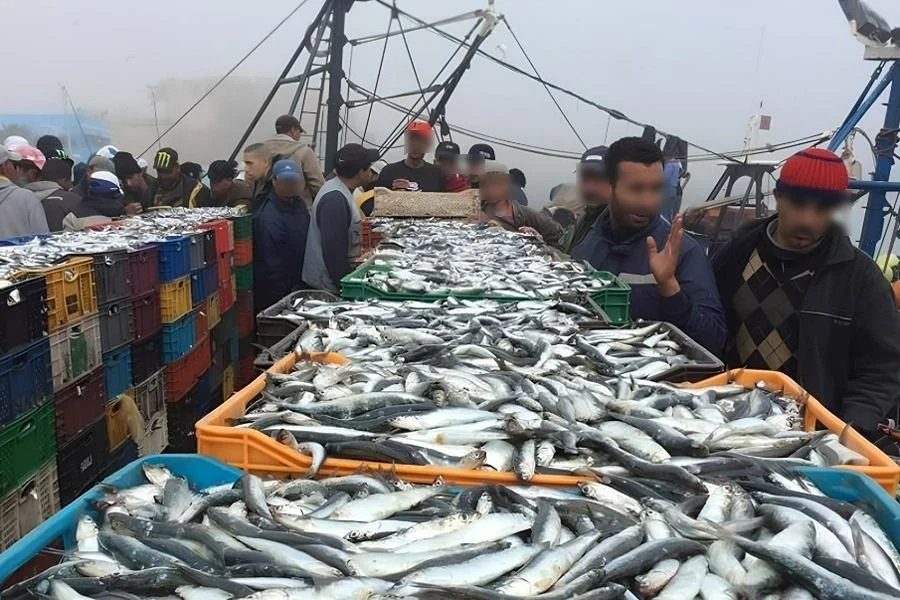
No case of Pilchard herpesvirus (PHV) has been officially reported in Morocco, and nothing currently confirms the pathogen is circulating in Moroccan waters, but sardine die-offs recorded since early August along South Africa’s coast have put the virus back in scientists’ sights, Le Matin daily reports. On August 14, South African authorities confirmed genetic material from PHV in analyzed sardines; of the first 15 specimens examined, all tested positive, with high levels in the ten sardines linked directly to the mortality episodes, and the sequence studied showed 99.7 percent similarity to a virus gene identified in Australia.
Hassan Saadouni, an economic operator and president of the CGEM Marrakech-Safi Coastal and Blue Economy Commission, has publicly called for vigilance without alarmism, describing sardines as an economic, social and strategic resource sustaining a chain from coastal fishing to canneries, employment, transport, exports and domestic supply, particularly in Safi. He is urging stronger scientific monitoring, greater laboratory capacity, closer coordination between researchers, administration and industry, and rapid reporting for unusual mortality events.
The concern draws heavily on Australia’s precedent: researcher Brian Jones, who studied the country’s major PHV epizootics of 1995 and 1998-1999, told Le Matin the virus is highly contagious, with infected but still-asymptomatic sardines capable of joining other schools and transmitting it before dead fish make an outbreak visible. The 1995 episode spanned more than 5,000 kilometers of Australian coastline and into New Zealand; 1998-1999 was worse, wiping out roughly 60 percent of sardine biomass in southern and western Australian waters and forcing two of Western Australia’s three sardine fisheries to close for a season, with losses exceeding 12 million Australian dollars in the first episode and 15 million in the second.
Rosemary Dorrington, a microbiology professor at Rhodes University involved in the South African analyses, told Le Matin her team detected high PHV levels in all dead fish tested, with symptoms and spread speed consistent with the first Australian outbreak, though she remains cautious about the exact mechanism, noting the virus also turned up at varying levels in a small sample of live fish. She recommended Morocco establish routine PCR-based monitoring of sardine catches, offering to share her lab’s protocols with Moroccan colleagues, while advising fresh or frozen sardines from South Africa be treated as potentially infectious until the outbreak is confirmed over.
Morocco does not start from zero on fisheries monitoring, with the National Institute of Fisheries Research tracking small pelagic stocks through scientific surveys, and fish product imports subject to health certificates overseen by ONSSA. But available public information does not indicate routine, PHV-specific screening is currently applied to Moroccan sardines, a gap Dorrington’s recommendation and Saadouni’s call for vigilance both point toward closing before, rather than after, any local outbreak makes itself visible.