Morocco is mobilizing close to 200 billion dirhams (20 billion dollars) in public and private investment to transform its economy, infrastructure, and tourism sector ahead of co-hosting the 2030 FIFA World Cup, according to a detailed report by the daily Les Inspirations Éco.
The Kingdom is treating the centenary World Cup not merely as a sporting event but as a catalyst for long-term structural change. The government has earmarked more than 190 billion dirhams for transport, mobility, hospitality, and urban facilities.
Officials point to the successful economic impact of the 2025 Africa Cup of Nations. The tournament generated over €2 billion in returns from roughly €1 billion in sports investments, involved 3,000 local companies, and created more than 60,000 direct and indirect jobs.
The African Cup of Nations was a test and a proof of concept for Morocco’s World Cup organization.
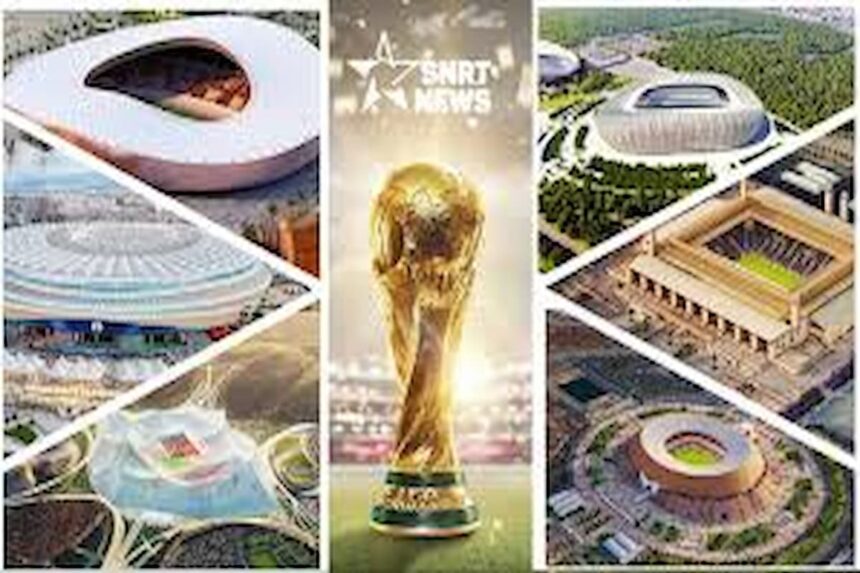
Key infrastructure projects include the renovation of six existing stadiums in Tangier, Rabat, Casablanca, Fez, Marrakech, and Agadir to FIFA standards, alongside the construction of the massive Hassan II Grand Stadium in Benslimane.
Designed to hold 115,000 spectators, the new venue is being built with advanced methods such as BIM and Lean Construction and is positioned to host either the opening match or the final.
The high-speed rail network will expand by 430 kilometers to connect Kenitra and Rabat with Marrakech.
Regional express networks are being developed around Casablanca, Rabat, and Marrakech. The national motorway network will grow from 1,850 km to 3,000 km by 2030, driven by projects such as the Rabat–Casablanca continental highway and the Tit Mellil–Berrechid route.
Casablanca’s Mohammed V Airport will gain a major third terminal to strengthen its role as an intercontinental hub.
After welcoming nearly 20 million visitors in 2025, Morocco aims to reach 26 million tourists by 2030.
To support this target, 60,000 additional hotel beds will be added to a national capacity already exceeding 300,000, ensuring accommodation for World Cup fans while securing long-term occupancy for a sector that contributes about 7% of GDP.
The preparation entered a more operational phase during a recent tripartite business forum involving Morocco’s CGEM, Spain’s CEOE, and Portugal’s CIP at the Mohammed VI Football Complex.
The gathering underscored a strong public-private partnership model that integrates the national business community.
Morocco continues to project solid economic fundamentals, with growth expected above 5%, inflation around 1%, and record levels of foreign direct investment.
At least 35 cities will see direct gains through sanitation, urban regeneration, environmental upgrades, and public space improvements.
By spreading opportunities across small and medium-sized enterprises throughout the value chain, Morocco is positioning the 2030 World Cup as a foundation for sustained economic and social progress rather than a one-month spectacle.