Romania affirmed it believes that “genuine autonomy under Moroccan sovereignty could be a viable solution” to the issue of the Moroccan Sahara.
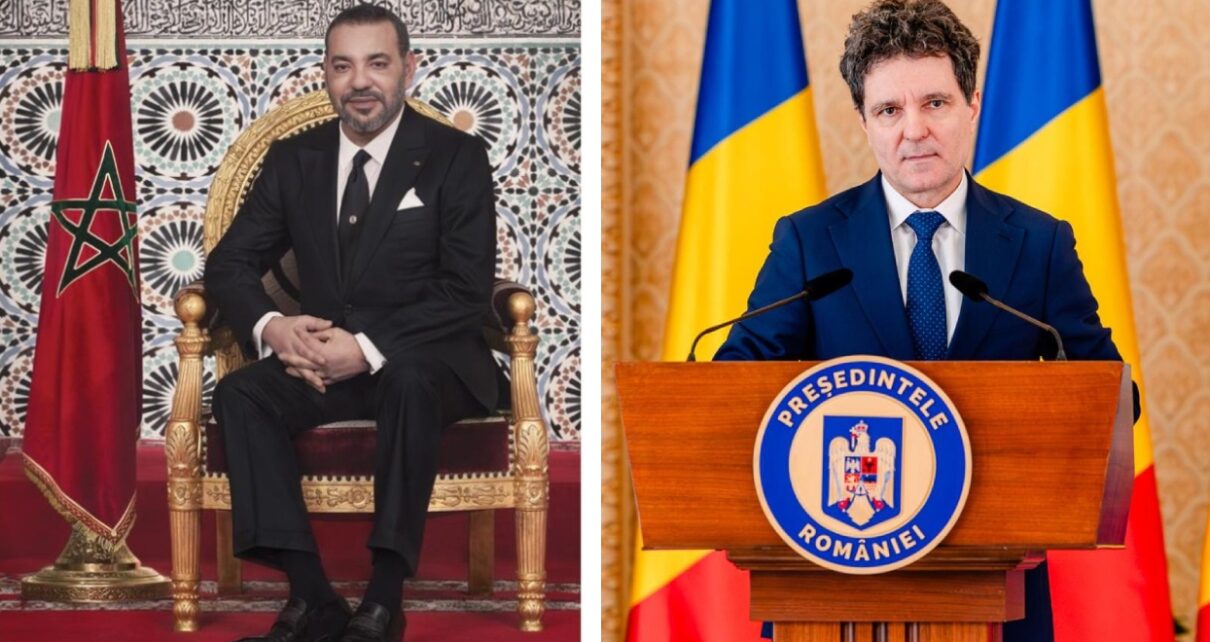
This came in a message Romanian President Nicușor Dan addressed to King Mohammed VI.
“We note that genuine autonomy under Moroccan sovereignty could constitute a viable solution,” President Nicușor Dan emphasized in his message, adding that Romania “considers that the autonomy plan presented by Morocco in 2007 constitutes the most appropriate, serious, credible, and realistic basis for reaching a just, lasting, and mutually acceptable political solution.”
This stance comes “following an in-depth analysis of developments in the Sahara issue… an issue of major interest to the Kingdom of Morocco,” the Romanian President said.
“Romania was among the first States to adopt a position of support for the Kingdom of Morocco on the issue of the Sahara… and commended in 2022 Your Majesty’s efforts,” President Dan recalled, adding that his country “believes that the current context provides the necessary framework for the evolution of its national position, in full compliance with its European and global commitments.”
The message addressed to the King was delivered Monday to Minister of Foreign Affairs Nasser Bourita by Advisor to the Romanian President and former Prime Minister Dacian Ciolos.
In a statement to the media following his meeting with Bourita, Dacian Cioloș recalled that Morocco is Romania’s main partner in the MENA region, and praised the decades-long excellent cooperation and partnership ties between the two countries in the diplomatic, economic, and educational spheres.
A candidate for the position of Secretary General of the International Organization of Francophonie (OIF), Cioloș highlighted Morocco’s key role for Francophonie, given its close ties with French-speaking countries in Africa, Europe, Asia, and the Middle East.
In this regard, he called for a Francophonie adapted to the changes in the contemporary world and better aligned with the expectations of young people, emphasizing French’s importance as a language of opportunity that promotes access to employment, entrepreneurship, and bolstering regional and international cooperation among French-speaking countries.
Linguistic proximity and a shared attachment to the French language have greatly contributed to closer ties between the two countries, Cioloș noted, recalling that Romania is one of the most Francophone countries in Eastern Europe.
Concerning educational cooperation, Cioloș said that over 1,200 Moroccan students are currently pursuing their studies in Romania, highlighting the significant contribution of this educational exchange to boosting relations between the two countries.
On the economic front, Cioloș pointed to “very significant” potential for cooperation, particularly in the automotive and construction sectors, where several Romanian companies have made investments in Morocco.
Romania’s position on the Sahara forms part of the international momentum generated under the impetus of King Mohammed VI in support of Morocco’s sovereignty over its Sahara and the Moroccan autonomy Plan.
Some thirty European countries, including 24 EU member States and over two-thirds of UN member States worldwide, are actively participating in this momentum.