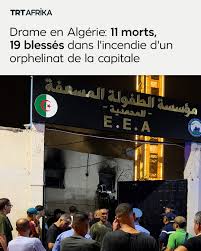
Eleven dead, ten of them children with no parents left to bury them. Two days on, the Mohammadia orphanage fire has become as much a story about accountability as about tragedy.
Across Algerian social media and in parts of the press, the state was severely criticized for its slow response and safety failures.
Eleven months ago, President Abdelmadjid Tebboune decreed a national day of mourning within hours of a bus accident that killed 18 people. This week, facing the deaths of children who had already lost everything, he did not.
The fire broke out around 3:30 a.m. on Thursday, July 16, at the Établissement de l’enfance assistée de Mohammadia, a state-run facility housing orphaned, abandoned, and vulnerable children, some with special needs.
Algeria’s national police agency said its forensic examination pointed to an electrical spark from an air-conditioning unit on the building’s first floor as the fire’s likely origin.
The tragedy struck the day after Algeria’s National Children’s Day and in the middle of a punishing heat wave that has fed hundreds of wildfires nationwide. Nearly 1,000 blazes were recorded in the week leading up to the fire, with Kabylie provinces including Tizi Ouzou, Bejaia and Boumerdes among the areas where firefighting operations were still active this week.
President Tebboune was in Berlin when the fire broke out. He issued a written condolence message from Germany. He did not declare a national day of mourning, the formal gesture that accompanies Algeria’s most significant tragedies.
The last time the mourning was declared was on August 15, 2025, a passenger bus skidded off a bridge into a sewage river, killing 18 people.