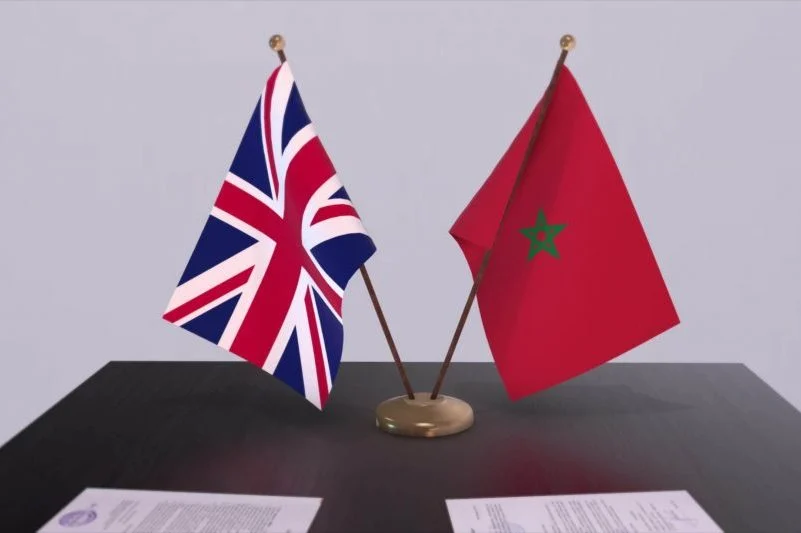
Morocco and the United Kingdom have formalized a significant update to the commercial framework governing their bilateral trade, with the signing of Decision No. 01/2026 of the Association Council on 16 March 2026. The decision amends Protocol 4 of the Association Agreement between the two countries, which covers the definition of originating products and the methods of administrative cooperation used to certify preferential treatment at the border. Morocco’s Customs and Indirect Taxes Administration (ADII) published a circular setting out the changes in detail.
The amendments address several operational dimensions of the trade relationship. Under the updated cumulation rules, manufacturing or processing operations carried out in Iceland, Norway, the European Union, Morocco, Algeria or Tunisia are to be treated as having been performed in the United Kingdom, provided the resulting products undergo further processing in the UK before export. This broadens the geographic scope of what qualifies as UK-origin content, giving manufacturers in both countries more flexibility in structuring their supply chains.
The revised direct transport rule establishes that preferential tariff treatment applies only to goods transported directly between Morocco and the UK. However, transit through third territories is permitted under defined conditions: goods must remain under the surveillance of customs authorities in the transit country and may only undergo operations such as unloading, reloading, consignment splitting or preservation measures — not further transformation. The decision also updates procedures for the issuance of EUR.1 and EUR-MED certificates of origin, and clarifies the conditions governing supplier declarations.
The technical update lands as the bilateral trade relationship is gaining in scale and ambition. Exchanges between Morocco and the UK reached $5.75 billion in 2024, led by automotive and energy sectors. Since the post-Brexit Association Agreement entered into force, Moroccan exports to the UK have almost tripled. Potential public procurement opportunities accessible to British companies in Moroccan infrastructure, energy and logistics sectors are estimated at approximately £33 billion, a figure that attracted close to fifty British companies to a Morocco-UK Business Forum held in Rabat and Casablanca on 2 and 3 June 2026.
The forum brought together government representatives, business leaders and investors to translate the strategic bilateral relationship into concrete economic outcomes, with particular focus on the short-term needs generated by Morocco’s major infrastructure projects and World Cup 2030 preparations. Both governments have stated an ambition to double bilateral trade flows and accelerate investment. The decision adopted in March provides the technical infrastructure to support that ambition as volumes and complexity grow.