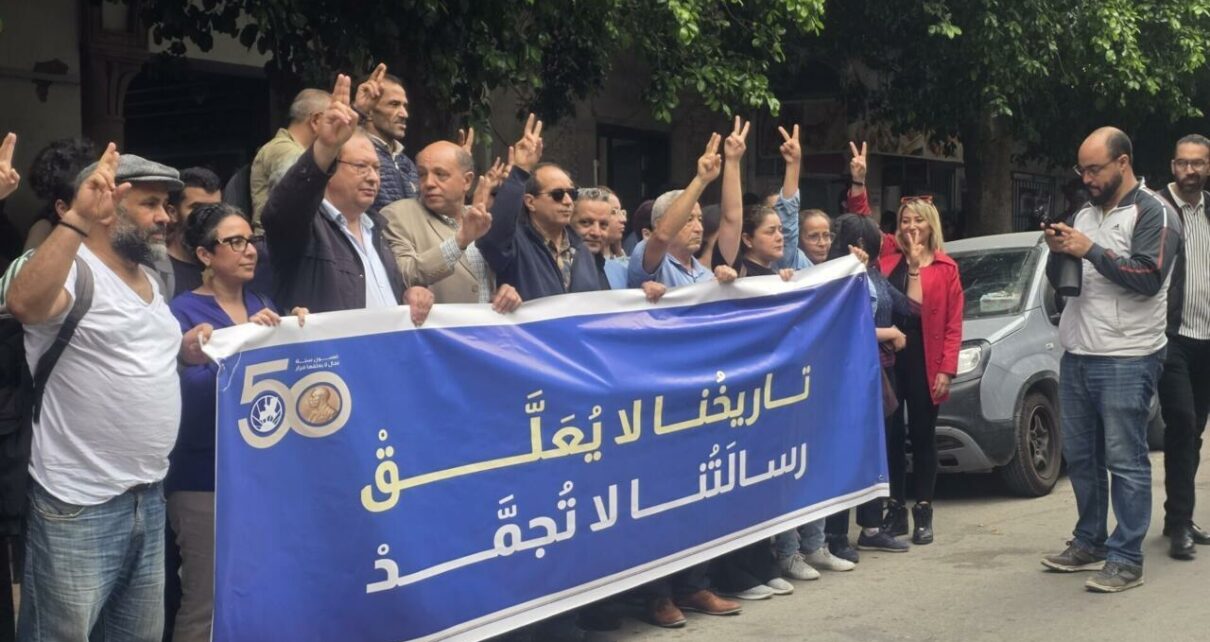
Human Rights Watch has condemned the decision of the Tunisian authorities to suspend operations of the Tunisian League for Human Rights, a longstanding refuge for human rights defenders.
Founded in 1976, the league has been repeatedly targeted since its inception. Many of its leaders were arbitrarily arrested under the governments of both Habib Bourguiba and Zine el-Abidine Ben Ali. Yet the organization withstood the attacks, ultimately outlasting both dictatorships.
In the aftermath of the 2011 revolution, it played a crucial role in Tunisia’s democratic transition as part of the Civil Society Quartet, which was awarded the Nobel Peace Prize in 2015.
The Tunisian authorities had previously arbitrarily restricted the league’s activities in prisons. The Ministry of Justice stopped honoring the memorandum of understanding that governed its monitoring visits to prisons and detention centers, de facto barring the only independent nongovernmental organization (NGO) in the country such access.
The Tunisian League for Human Rights joins a long list of at least 20 civil society organizations the authorities have arbitrarily suspended since July 2025, in an unprecedented crackdown and a clear weaponization of the country’s administrative and legal processes alongside arrests and abusive prosecutions.
Avocats Sans Frontières (Lawyers Without Borders), a prominent NGO based in Tunis, has received lately a court-ordered suspension notice. The consequences of this are particularly devastating for the hundreds of people relying on its legal aid services, the only operation of its kind in the country.
These recent suspensions are part of the Tunisian authorities’ campaign to dismantle civil society, immobilizing organizations that have for decades defended human rights and access to justice.
Since July 2021, Tunisia has experienced a significant decline in human rights under President Kais Saied, who has consolidated power through constitutional changes, dissolved parliament, and weakened judicial independence. Authorities have increasingly used courts, arbitrary detentions, and restrictive laws to suppress political opponents, journalists, and civil society, marking a shift toward authoritarianism.