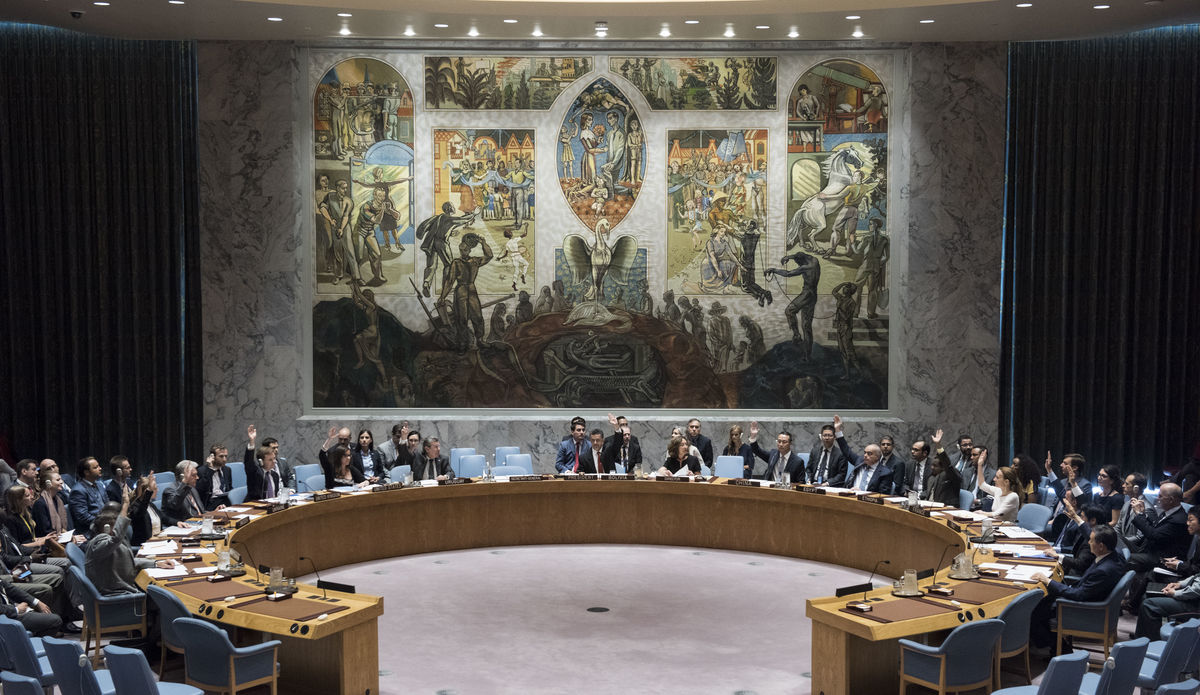
UN Security Council has decided to hold two meetings this month on the Sahara, dashing all hopes of the Algerian regime and its Polisario militias that the ongoing Middle East war would shift the Council’s focus and reset its priorities.
The first Sahara meeting is planned for April 24, while the second is set for April 30 with a strategic review of the MINURSO. These meetings build on the diplomatic momentum spearheaded by the U.S. and United Nations following the adoption of the historic UNSC resolution 2797 endorsing Morocco’s Autonomy plan under the Kingdom’s sovereignty.
During the April meetings, Security Council members will receive closed-doors briefings by Head of MINURSO Alexander Ivanko and UN Sahara envoy Staffan de Mistura on the progress of the UN-led political process based on resolution 2797. They will also assess the performance of the UN Sahara mission amid Trump’s new policy of eliminating failed UN peacekeeping missions to streamline bureaucracy, reduce costs and restore accountability.
Furthermore, the UN Security Council has changed its approach in handling the Sahara issue with the debate no longer focusing on the possibility of finding a solution, but rather on enforcing the Moroccan Autonomy plan under the Kingdom’s Sovereignty to put an end to a regional conflict that has remained unresolved for over half a century.
In resolution 2797 adopted last October, the Council expressed its full support for the Secretary-General and his Personal Envoy in facilitating and conducting negotiations, taking Morocco’s realistic Autonomy proposal as a basis for achieving a just, lasting, and mutually acceptable resolution of the dispute.
The resolution also called on the four parties to the conflict (Algeria, Morocco, Mauritania and Polisario), to engage in discussions without preconditions, using the Moroccan proposal as a basis, with a view to reaching a final and mutually acceptable political solution.
The resolution 2797 was adopted with 11 votes in favor, three abstentions (China, Pakistan, and Russia), while Algeria, which was sitting at the Council as a non-permanent member, did not vote. Three of the “Big Five” with veto power, the U.S., France and UK, backed the Moroccan Autonomy plan submitted to the UN in 2007.
Recent months have seen increased US momentum to advance efforts to resolve the Sahara dispute. On January 22, a delegation from the Polisario Front was summoned to Washington to assess their compliance with UNSC resolution. Four days later, U.S. Senior presidential Advisor Massad Boulos visited Algiers and met with several senior Algerian officials, including President Abdelmadjid Tebboune and Foreign Minister Ahmed Attaf.
In early February 2026, the U.S. convened ministerial-level delegations from Algeria, Mauritania, Morocco, and the Polisario Front for talks in Madrid. US Permanent Representative to the UN Mike Waltz and Boulos attended the meeting, which was co-chaired by de Mistura. It marked the first time since 2019 when all stakeholders met in person, which was under UN auspices.
Following the Madrid meeting, the U.S. hosted another quadripartite meeting in Washington on the Sahara on February 23 and 24, with de Mistura co-chairing the talks.
However, the outcome of these meetings remained unclear amid reports citing reluctance of Algeria and Polisario to comply with UN Security Council resolution 2797, using procrastination tactics. This has irked the Trump administration and U.S. lawmakers pushing for actions against peace spoilers.
At the U.S. Congress, bipartisan bills have been submitted to the House of Representatives and the Senate to designate the Algeria-backed separatist group as FTO, leading to severe sanctions against Polisario and its supporters.