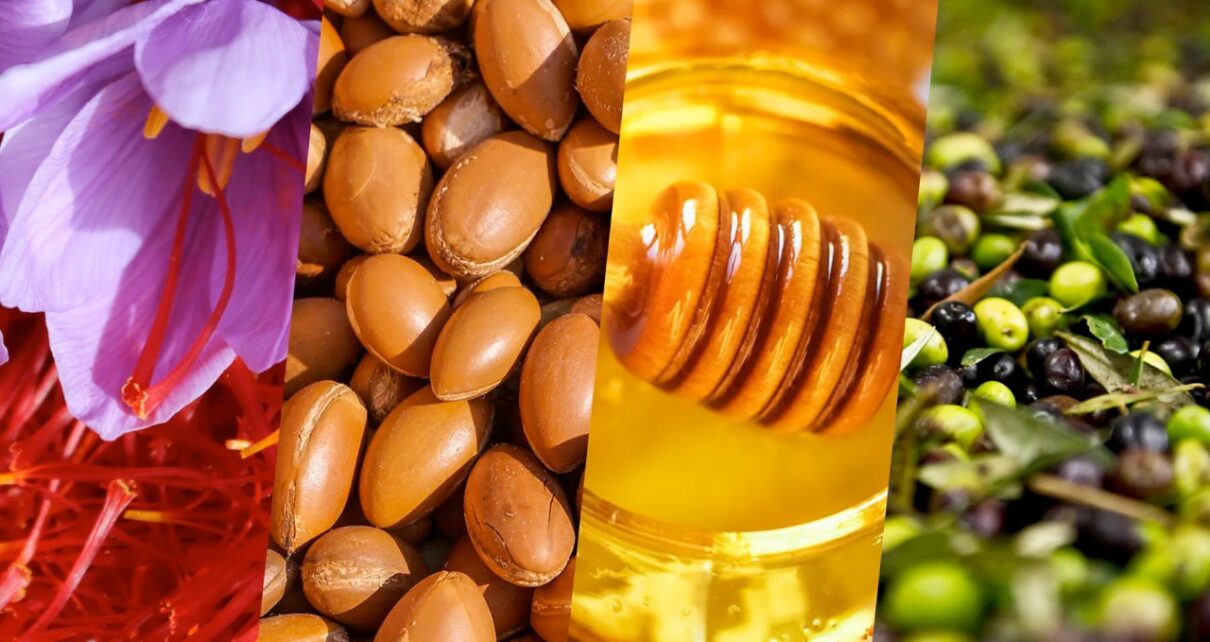
Morocco’s Ministry of Agriculture is accelerating its labeling agenda, with several emblematic local specialties — including olive oils, honey, and dried fruit — set to receive Protected Geographical Indication (PGI) status in the coming months.
The push is being driven through technical assistance launched by the Regional Directorate of Agriculture for the Fès-Meknès area. Among the products currently in the pipeline are Zerhoune Olive Oil, Lemta Fès Olive Oil, Sefrou Olive Oil, Outat El Haj Olive Oil, Guerrouane Olive Oil, Bouiblane Massif Zendaz Honey, and Aknoul Almond. Obtaining PGI certification would confirm their geographical authenticity and quality standards, both domestically and in export markets.
The initiative draws its legal foundation from Law 25-06 on distinctive signs of origin and quality, enacted in 2008. Since its introduction, 80 products have received recognition between 2009 and 2023, encompassing 68 geographical indications, six appellations of origin, and six agricultural labels. Categories range from olive oils and fresh or dried fruits to aromatic plants, honey, and cheese.
The Fès-Meknès region stands out as a national leader in this domain, with nine certified products already to its name, including Ifrane Apple, Taounate’s Nabout dried fig, and several of the olive oils now awaiting upgraded certification.
The Ministry frames terroir product development as one of the landmark achievements of the Green Morocco Plan, which concluded in 2020, and a proven engine for sustainable development in rural and economically disadvantaged areas. International precedent, it notes, confirms that structurally challenged regions can successfully reinvent themselves through value-driven terroir strategies.
The current momentum is sustained by the Generation Green 2020-2030 strategy, which places solidarity-based agriculture and terroir valorization at the heart of Morocco’s agricultural vision for the decade. Each labeled product must meet a detailed specification sheet, verified by accredited control and certification bodies whose compliance plans are validated by the national commission on distinctive signs of origin and quality. This traceability framework is designed to protect producers, reassure consumers, and credibly position Moroccan terroir products on the global stage.