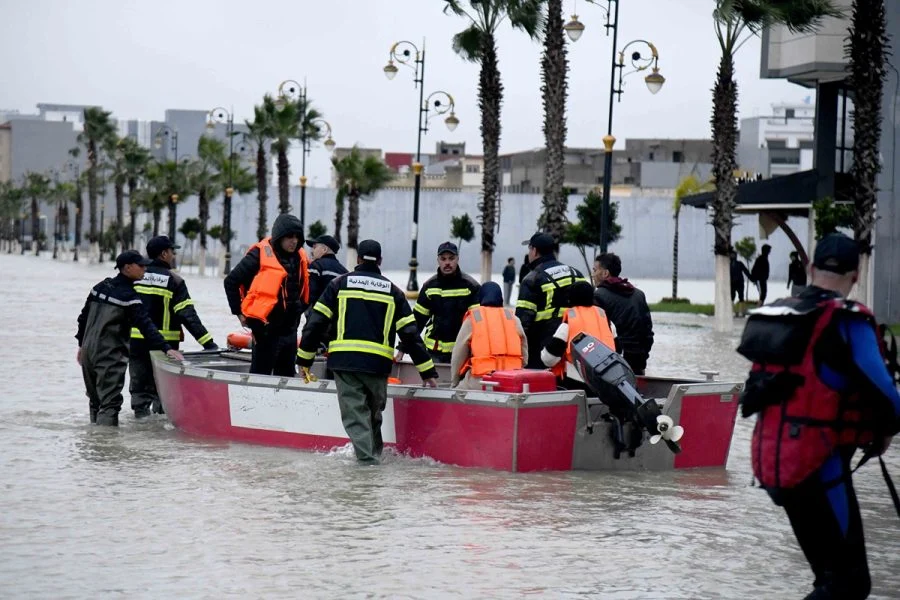
More than 54,000 residents have been evacuated from Ksar El Kebir since Friday as rising waters from the Loukkos River flooded large parts of the northern Moroccan city, according to Moroccan media.
An additional 650 people were relocated on Tuesday alone from a temporary camp, which became threatened as water levels continued to climb.
According to meteorologist and hydraulic engineer Mohamed Jalil, cited by le360, the flooding is not the result of local rainfall but of a large-scale fluvial event affecting the entire Loukkos basin.
Heavy rains in the Rif, Middle Atlas and northwestern regions over recent weeks saturated soils and generated sustained runoff, feeding major tributaries upstream.
“The water submerging Ksar El Kébir is not the water that fell on the city, but that of the whole Loukkos basin,” he said.
Experts noted that the city lies in the downstream portion of the Loukkos plain, a historically flood-prone area where the river loses slope and spreads.
Hydrologist Amine Benjelloun told the media the plain’s flat topography slows drainage toward the Atlantic, allowing rising water to accumulate.
Comparable conditions have long existed in other major Moroccan floodplains, including the Sebou basin in the Gharb.
The Oued El Makhazine dam, commissioned in 1979 to regulate irrigation, drinking water supply and flood protection, reached and exceeded full capacity amid successive Atlantic disturbances, officials said.
When a dam reaches maximum storage, it loses its buffer function. “A full reservoir can no longer attenuate incoming flows. What enters essentially exits with the same intensity,” Jalil explained.
The situation was further exacerbated by rough seas. High tides and heavy surf created a hydraulic “back-pressure,” slowing the river’s outflow and raising water levels in the floodplain.
The Royal Armed Forces (FAR) were deployed to provide logistics, transportation and emergency accommodation, according to an official statement.
Hydrologists warned that receding waters may take days due to the plain’s limited slope and the high volumes currently stored across fields and low-lying areas. Even after rainfall stops, elevated reservoir levels and continued upstream inflows can prolong risk. Rough seas could further delay drainage.