Morocco is unrolling its AI strategy centered around the Jazari institutes across the country hoping AI will add 100 billion dirhams (over $10 bln) to its economy, Minister Delegate in charge of Digital Transition and Administrative Reform Amal El Fallah Seghrouchni said.
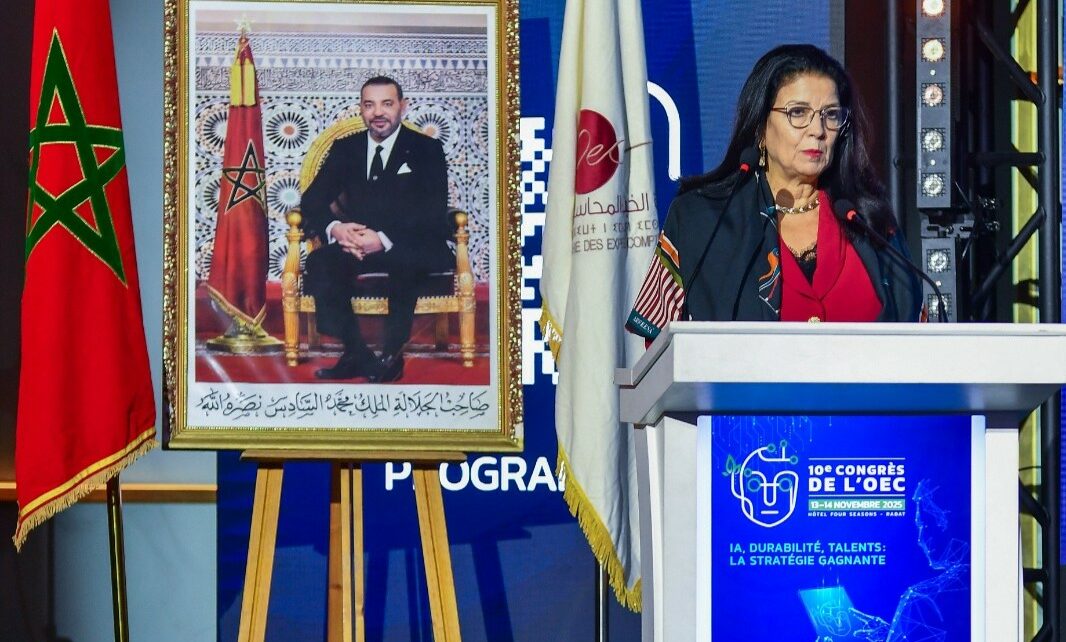
Speaking at a conference unveiling Morocco’s flagship plan: “AI Made in Morocco: Artificial Intelligence at the Heart of Digital Transformation and Public Services,” Seghrouchni highlighted that the initiative builds directly on the National AI Summit held in July 2025 under the high patronage of King Mohammed VI.
Those meetings, she recalled, delivered an unambiguous diagnosis, as AI has become a central instrument of economic, institutional and geopolitical power, and technological dependence is no longer an abstract risk but a concrete strategic vulnerability.
The AI development strategy would create 50,000 jobs and train 200,000 students, she said.
Citing projections from UNCTAD’s 2025 Technology and Innovation Report, the Minister noted that the global AI market could reach $4.8 trillion by 2033.
Yet she warned that the sector is increasingly characterized by a strong concentration of technologies, data and value chains among a limited number of countries and corporations. In this context, she said, Morocco has made a clear strategic choice: not to passively undergo the AI revolution, but to fully master it.
Anchored in the principles of the Kingdom’s New Development Model, Morocco has adopted a posture of “technological non alignment,” not as isolation, she stressed, but as a sovereign decision not to outsource its capacity to regulate, innovate or decide to systems designed elsewhere for interests that may not align with its own.
Early results are tangible: within one year, Morocco climbed 14 places in the 2025 Government AI Readiness Index, reflecting progress in public strategy, governance and institutional capacity building.
But the Minister cautioned that AI is neither neutral nor inherently inclusive. Without deliberate policymaking, it tends to amplify existing social, territorial and international inequalities. For this reason, she argued, states must act urgently by investing in sovereign digital infrastructure, strengthening national skills and establishing public governance of AI grounded in trust, responsibility and security.
Morocco’s vision, she said, is built around five political pillars: technological sovereignty; citizen trust; large scale capacity development; promotion of endogenous innovation; and territorial equity.
The centerpiece of this strategy is the creation of the national network of excellence centers known as the Jazari Institutes, a major structural component of the Morocco Digital 2030 agenda. Designed as a distributed national architecture rooted in local territories, the network will be closely linked to universities, government bodies, startups, SMEs and the wider digital economy. The launch of Jazari Root, the network’s coordinating hub, marks a decisive milestone in building Morocco’s long term national capability in artificial intelligence for both state and citizen.
According to the Minister, the Jazari Institutes are intended to become regional platforms for training, applied research and shared innovation, helping strengthen the institutional and economic capacities not only of Morocco but also of partner countries across Africa and the Arab world.
Monday’s “AI Made in Morocco” event is therefore more than a technical showcase; it is a politically significant moment. The agreements to be signed, the Minister said, represent concrete commitments to a sovereign, controlled and inclusive AI ecosystem grounded in territorial fairness.
Crucially, the initiative also carries a strong South–South cooperation dimension. In a global landscape where most AI technologies are designed in the Global North and exported to the South with limited transfer of know how, Morocco aims to propose a different model: one based on co construction of trusted, contextualized AI solutions developed with—and for—the countries of the Global South, in line with the vision of King Mohammed VI.
To reach the targeted goals, a General Directorate for AI & Emerging Technologies will be set up to oversee public policy along with the establishment of an Arab-African regional digital hub in partnership with the UNDP to encourage sustainable digital innovation.
The Minister concluded by expressing hope that the launch would generate rich discussion, ambitious ideas and operational perspectives, reinforcing Morocco’s determination to shape its digital future on its own terms.