Morocco has called for a rebuilding of partnerships between the shores of the Atlantic, to the benefit of Southern countries, which need today, more than ever, renewed and balanced partnerships.
The call was launched at the opening of the 14th edition of Atlantic Dialogues, held by The Policy Center for the New South, on Thursday, December 11, 2025, at the Mohammed VI Polytechnic University (UM6P) in Sale.
The conference stands as a crossroads bringing together the four Atlantic continents, with the ambition of renewing understanding of inter-Atlantic dynamics and highlighting the growing strategic role of the South Atlantic in global economic and geopolitical debates.
In a context of multilateralism in crisis, technological rivalries, and climate pressures, the Moroccan think tank calls for a rebuilding of partnerships between the shores of the Atlantic, to the benefit of Southern countries, Karim El Aynaoui, executive president of the influential think tank said, underlining that countries of the South today “more than ever need renewed and balanced partnerships.”
He added that this gathering is intended to be an open space where we can meet and engage in constructive and reasonable discussion in line with the Vision of King Mohammed VI.
Over the years, “The Atlantic Dialogues” has embodied “a culture of structured and organized debate that the Center strives to disseminate, promote, and transmit to younger generations in Morocco and beyond, he noted, adding that “holding this conference at UM6P is no coincidence. It is part of the continuity of a sophisticated intellectual infrastructure that we are working to build” within the PCNS.
He also pointed out that crucial themes such as North–South relations, the promotion of multilateralism, and the influence of regional groupings have always been at the heart of the Conference’s debates and discussions since its launch in 2012.
The conference stands as a crossroads bringing together the four Atlantic continents, with the ambition of renewing understanding of inter-Atlantic dynamics and highlighting the growing strategic role of the South Atlantic in global economic and geopolitical debates.
The debates of this first day of Atlantic Dialogues were largely dominated by the major themes affecting global governance: the crisis of multilateralism, the weakening of democratic models, the growing role of artificial intelligence (AI) in power relations, Donald Trump’s return to the forefront of the international scene, as well as the reconfiguration of North-South and South-South partnerships across the two shores of the Atlantic.
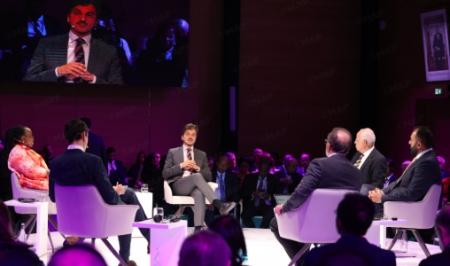
The conference features nine plenary sessions covering a range of themes, along with twenty small-group workshops, providing an ideal setting for in-depth discussions on Atlantic dynamics and the emerging challenges of international cooperation. A first panel examined democracy’s ability to deliver on its promises in a world marked by eroding trust and profound transformations
The conference addresses topics that have received limited attention, such as the growing importance of international maritime corridors as strategic commons for global trade, the reduction of geopolitical tensions, and the protection of marine ecosystems.
During the opening session, the Center unveiled the 12th edition of its annual report before a large audience made up of Moroccan and foreign academics, diplomats, political scientists and former ministers from diverse backgrounds. This year’s report is titled: “The Wider Atlantic: Building Partnerships in an Era of Instability.”
The PCNS’s 12th report, coordinated by Ambassador Mohammed Loulichki, a researcher at the center, offers, according to a press release, “an in-depth reflection on the dynamics at work in the wider Atlantic.” The document examines how “this space can become a structuring framework for cooperation and pragmatic partnerships at a time when geopolitical rivalries, technological transformations and climate pressures are redefining the international order.”
This new edition thus highlights the strategic role of the wider Atlantic as a platform for dialogue and the reconfiguration of partnerships, in a context where international instability calls for both national resilience, concerted responses and innovative forms of cooperation.
Structured around seven major sections broken down into thirty-three chapters, the report brings together around forty contributions from authors in the public and private sectors, as well as from international organizations, representing twenty countries, including eighteen Atlantic coastal states. Substantively, this twelfth edition continues and deepens the lines of reflection opened by previous editions, “broadening the field of analysis to better grasp the scale of the ongoing transformations,” the press release notes.
The report notably highlights “the global competition around emerging technologies — artificial intelligence, cybersecurity, control of critical resources, or deepwater activities — which is reconfiguring alliances and reinforcing the centrality of innovation in the geopolitical hierarchy.”
By offering “a structured overview of contemporary debates and emerging ideas,” the PCNS believes this latest report provides readers “with a reference tool to understand the profound reconfigurations of a transitioning Atlantic space and to sketch the contours of a more connected, more cooperative and more solidaristic future for the peoples who make it up.”
The Atlantic Dialogues aim to foster concrete exchanges that lead to tangible outcomes, bringing together a community of over 2,000 participants who share a renewed vision of Atlantic challenges and opportunities. Debates encourage open and informal interactions between the audience and experts.
Alongside the conference, the Policy Center for the New South is organizing the 12th edition of the Atlantic Dialogues Emerging Leaders (ADEL) program, targeting 40 young professionals aged 25 to 35, primarily from countries across the Atlantic region.
The Atlantic Dialogues will continue until December 13, 2025, with a series of roundtables and thematic panels led by high-level international experts.