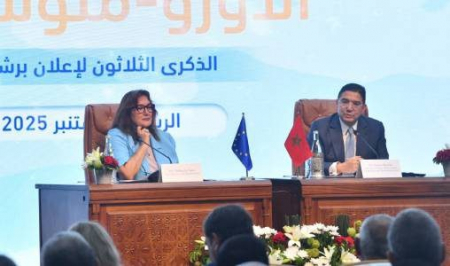
Morocco’s foreign minister, Nasser Bourita, called for a sweeping reform of the Euro-Mediterranean Partnership, arguing that the region must evolve into a space of concrete cooperation and shared responsibility rather than remain a symbolic or fragmented initiative.
Speaking at the opening of a high-level retreat in Rabat focused on the future of Euro-Mediterranean relations, Bourita offered a candid appraisal of the Union for the Mediterranean and the broader regional framework.
He urged participants to adopt a bold and actionable roadmap to reinvigorate the partnership, which, he said, has lost its centrality amid proliferating geopolitical tensions and competing initiatives.
“The Mediterranean is not merely a sea or a border—it is a shared ecosystem and a common good,” Bourita said. “When we treat it as a file to be managed, it slips away. When we treat it as a common good, it brings us together.”
Morocco, he said, was a natural and legitimate host for this strategic reflection, citing the country’s longstanding engagement, reliability, and methodical approach.
He pointed to Morocco’s pioneering role in the partnership, including its early adoption of Advanced Status, the establishment of a subcommittee on human rights, and its commitments in mobility and environmental cooperation.
Bourita emphasized that Morocco has consistently translated political commitments into tangible actions, particularly through bilateral cooperation with European partners such as Spain, France, and Germany.
He also called for a shift in perspective, urging stakeholders to stop treating the southern Mediterranean as a peripheral concern and instead recognize it as an equal partner in shaping the region’s future.
The minister outlined several structural challenges facing the Euro-Mediterranean process, including a lack of clarity about its identity and objectives, uneven levels of motivation among member states, and a failure to respond effectively to crises such as the COVID-19 pandemic, energy shortages, and food insecurity. He also noted that the initiative suffers from a lack of social visibility, often perceived as elitist and disconnected from the concerns of ordinary citizens.
To address these shortcomings, Bourita proposed a four-pronged strategy: securing strategic supply chains in energy and food; connecting regional economies through co-production platforms and strategic corridors linking the Mediterranean, Africa, and the Atlantic; mobilizing talent by transforming migration into opportunity through smart mobility and recognition of qualifications; and revamping political dialogue through a Mediterranean Political Forum under the umbrella of the Union for the Mediterranean.
He also introduced the idea of “voluntary coalitions,” flexible groupings of at least one northern and one southern country, designed to implement specific projects without being hindered by non-participating states.
Funding for these initiatives, he said, could be provided through a proposed Euro-Mediterranean Cohesion Fund, based on a hybrid guarantee mechanism.
Bourita stressed the importance of accountability and citizen engagement to restore the partnership’s legitimacy.
The retreat brought together policymakers, business leaders, and academics for open dialogue aimed at anticipating future challenges and responding to the aspirations of the region’s populations.