By all appearances, Algerian President Abdelmadjid Tebboune is engaged in a whirlwind of diplomatic activity. From Rome to Algiers, from energy deals to symbolic gestures, his administration projects an image of international engagement and strategic relevance. Yet, beneath the surface lies a troubling reality: Algeria is increasingly isolated, diplomatically marginalized, and economically strained. The flurry of handshakes and photo ops masks a foreign policy devoid of substance, coherence, or strategic direction.
Tebboune’s recent visit to Rome exemplifies this paradox. Italian officials rolled out the red carpet, not for Algeria’s geopolitical importance, but for its gas—sold at bargain prices that defy economic logic. While Algeria supplies over 40% of Italy’s gas needs, it does so at rates as low as $4–$5 per million BTU, far below the $11–$15 global LNG average. The result: billions in lost revenue for a country whose hospitals lack basic equipment and whose citizens drive decades-old vehicles. In exchange, Tebboune receives a veneer of legitimacy that neither Paris nor Washington is willing to offer.
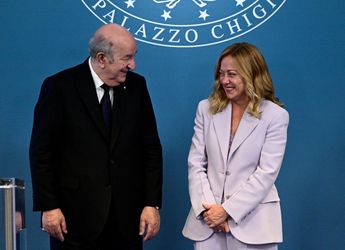
This pursuit of recognition has led to uncomfortable contradictions. Tebboune has cozied up to Giorgia Meloni, Italy’s far-right leader, while his regime routinely vilifies critics at home by associating them with the French far-right. The irony is stark: Algeria’s “New Era” praises extremism abroad while condemning it domestically. Such inconsistencies underscore a foreign policy driven more by optics than principles.
Back home, the Algerian government continues to trumpet hollow victories. The visits of mid-level representatives from ExxonMobil and Chevron were hailed as breakthroughs, despite yielding nothing more than vague promises of exploratory studies over the next decade. No CEOs, no signed deals, just symbolic meetings repackaged as economic triumphs. Meanwhile, the United States reaffirmed its support for Morocco’s sovereignty over the Sahara territory, further sidelining Algeria on a dossier it considers existential.
In a desperate bid to appear generous and influential, Algeria pledged $200 million to rebuild southern Lebanon-a Hezbollah stronghold- while neglecting its own impoverished southern regions. This “gift,” revealed not by Algerian media but through Russian and Lebanese sources, was neither a loan nor a structured partnership. It was a silent transfer of funds from a country that rations medicine and restricts imports to preserve dwindling foreign reserves.
When faced with mounting criticism, Tebboune resorts to exaggeration. In a recent press encounter, he claimed a Malaysian investor was preparing to inject $20 billion into Algeria, nearly half the country’s foreign currency reserves. The reality? Lion Group, a Malaysian conglomerate with an annual turnover of $2.4 billion, has shown interest since 2020 but has made no commitments. The numbers simply don’t add up.
Algeria’s foreign policy today resembles a stage play, complete with actors, props, and scripted lines, but lacking a plot. The proliferation of summits, memorandums, and ceremonial farewells cannot conceal the absence of strategic vision. As journalist Mohamed Sifaoui aptly put it, “This is no longer diplomacy, but a choreography of emptiness.”
Until Algeria replaces spectacle with substance, its diplomacy will remain a theater of shadows, designed not to serve the nation’s interests, but to distract from its failures. The question is no longer whether the world takes Algeria seriously, but whether Algeria takes itself seriously.