Morocco’s role in Europe’s electricity security is gaining new dimensions, as both Spain and Portugal study expanded interconnections with the Kingdom while Morocco simultaneously builds out its own infrastructure toward sub-Saharan Africa. The developments unfold against the backdrop of the April 2025 Iberian blackout — the worst in Europe in two decades — in which Morocco’s existing submarine connections proved decisive in restoring the Spanish grid.
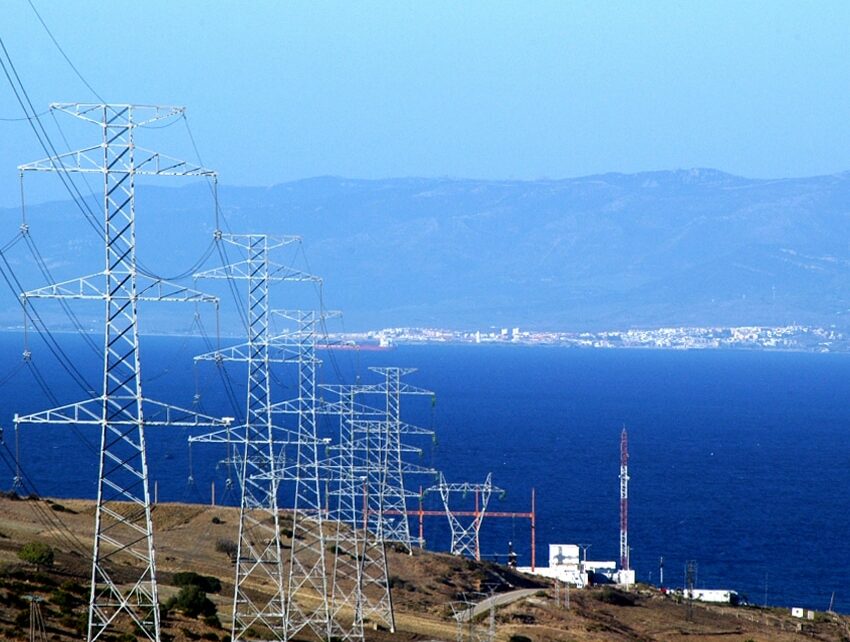
During the April 28, 2025 blackout, ONEE agreed to supply up to 100 megawatts via one of the two 700-megawatt submarine cables linking the two countries. Moroccan voltage support began at 13h04, enabling the restoration of southern Spain’s grid from the Tarifa 400-kilovolt substation. Despite a temporary disconnection at 14h27 triggered by a protective relay, the link was restored from Morocco at 14h34 and maintained until 19h18, when the entire Iberian system was reconnected to the European grid. The episode underscored both the value of the link and a structural fragility: maintaining the interconnection during the Iberian collapse required careful management to avoid cascading Morocco’s own grid.
Portugal, which inaugurated a new interconnection with Spain on 2 July 2026 but still describes the Iberian Peninsula as an “energy island,” announced on 6 July that it is studying the feasibility of a direct electricity connection with Morocco. Spain, meanwhile, is revisiting a third interconnection with Morocco originally planned for 2026. Spain’s regulatory authority, the CNMC, has noted that project costs have nearly doubled to €434.6 million and has asked for a rigorous cost-benefit analysis, cautioning that final commissioning could slip to 2033-2034. Both projects are framed within the EU’s new T-MED initiative, launched in June 2026 to promote green electricity interconnection with the southern Mediterranean.
In parallel, Morocco is developing a southward energy corridor. A topographic study has just been launched for a 400-kilovolt interconnection line of approximately 370 kilometers linking Dakhla to Boulenouar in Mauritania, connecting Morocco to the West Africa Power Pool (WAPP). To channel the massive renewable capacity under development in the southern provinces, ONEE is also preparing a 1,400-kilometre ultra-high voltage “green electric highway” linking Dakhla to Mediouna near Casablanca, with 3,000 megawatts of capacity. Geotechnical studies for this project are about to begin.
Further ahead, two flagship export projects would carry Moroccan renewable energy to northern Europe: the Sila Atlantik cable targeting Germany and the Qantara Med cable targeting France. Together with the Iberian links and the southern corridor, these projects frame Morocco’s emerging identity as a regional energy hub — at the intersection of European decarbonization ambitions and Africa’s expanding power markets.