Ahead of Morocco’s quarterfinal clash with France on Thursday evening, several French media have published analyses on the rising Moroccan football.
For French weekly magazine Le Point, Morocco has become a major force in both African and world football, the result of a strategy driven at the highest level of government.
“Over the past four years, Morocco has built a record to the level of its ambitions: a semifinal finish at the 2022 FIFA World Cup in Qatar, the host and official winner of the 2025 Africa Cup of Nations, and now a quarterfinalist in the United States,” the magazine said in an article published Thursday under the title “How Morocco Became a Global Football Powerhouse.”
The author of the article recalled that at the first World Cup hosted by an Arab country, Morocco became the first Arab and Muslim nation to reach the semifinals. “The impact was immediate, with global public opinion praising the team’s flair and style of play.”
Four years later, the Kingdom has earned a new status and is now “considered a country to be reckoned with, one that could become a football powerhouse and even a potential title contender.”
Highlighting Morocco’s impressive run at the 2026 World Cup—including a draw against Brazil and consecutive victories over Scotland, Haiti, the Netherlands, and Canada—the magazine noted that “the Kingdom is steadily pursuing its sporting, economic, and community strategy” and is now “the sole representative of the 22 Arab countries, the 54 African nations, and the Muslim world.”
The French publication also stressed that the momentum that began in Qatar is ultimately aimed at the 2030 FIFA World Cup, which Morocco will co-host with Spain and Portugal. It added that this strategy is intended to drive broad-based development across the country.
Regarding the Thursday Morocco-France match, the magazine pointed out that “whether the Atlas Lions win or lose, they will already have achieved their objective.”
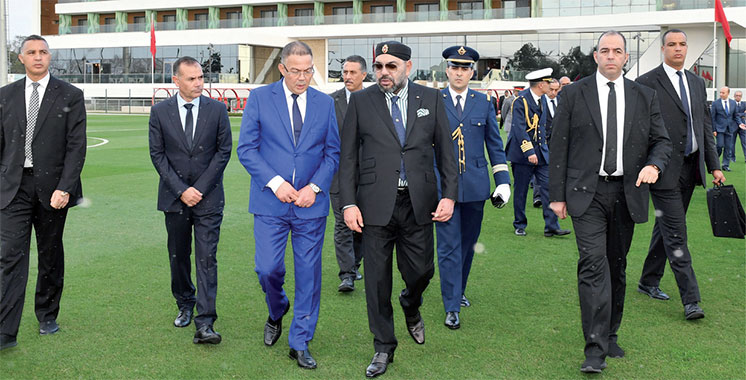
Another French channel, RMC Sport, highlighted the role of the Mohammed VI Football Academy that it described as a lever for high-performance, long-term football ecosystem, pointing out that the Kingdom “is world football’s new power.”
“This emergence involves the development of the Mohammed VI Academy and the economic strengthening of the local championship,” the specialized outlet stated in an article published on the eve of the Morocco-France clash in the quarter-finals of the World Cup.
For the author of the article, “seeing Morocco reach the quarter-finals of this 2026 World Cup is no longer a surprise,” as the Atlas Lions have established themselves among the best nations on the planet.
“This success is based on a global project, from the youth teams to the senior team, the same philosophy is applied,” says RMC, explaining that it is a question of “investing in training, developing infrastructure and building for the long term.”
This continuity at the highest level should allow Morocco to take a step forward by winning the first world championship title for an African team, RMC outlines.
Addressing the important results achieved on the field, the French media indicates that “youth selections regularly shine on the international scene, while the national team has entered a new dimension since its historic semi-final at the 2022 World Cup in Qatar.”
This dynamic is also reflected in significant investments around the team, particularly in logistics and in the quality of the skills that make up the national staff.
According to the outlet, the 2025 Africa Cup of Nations, perfectly organized, confirmed the Kingdom’s ability to host the biggest international sporting events on its soil. With four years to go before the World Cup that Morocco is set to co-host with Spain and Portugal, a large part of the infrastructure is already in place, concludes RMC Sport.