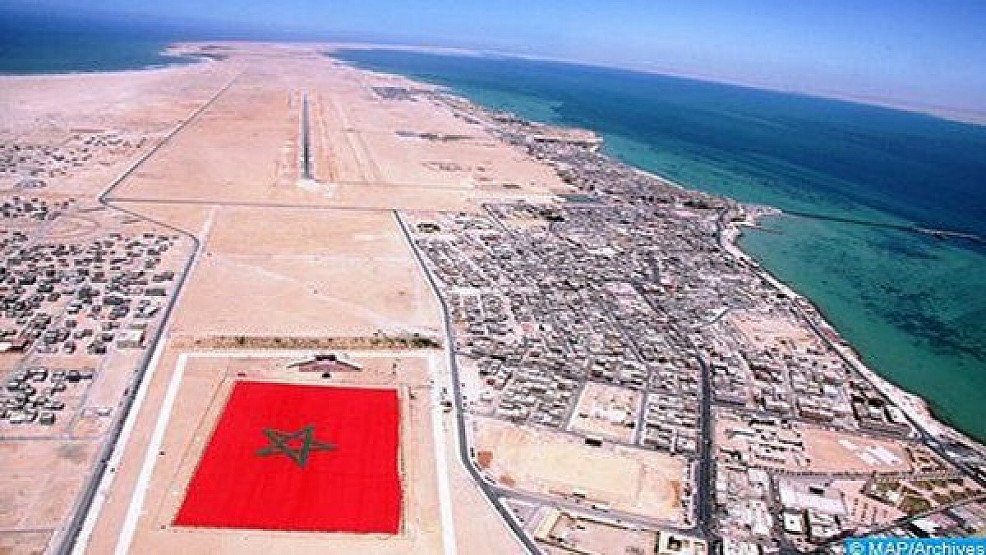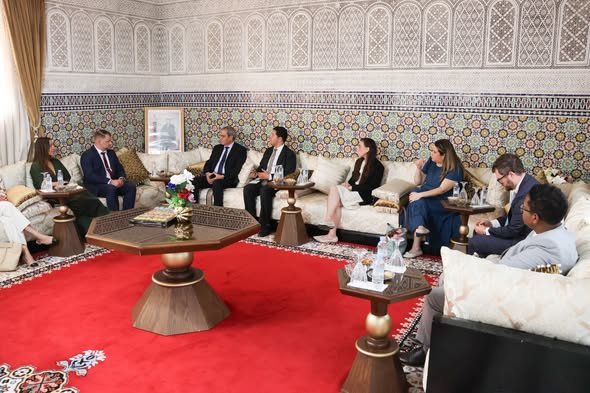
A delegation of political, economic and legislative staffers working for members of the United States Congress visited Dakhla on Wednesday where they discussed with senior Moroccan officials the economic potential of the Dakhla-Oued Eddahab region and the scope for deepening bilateral economic cooperation. The visit forms part of the ongoing dynamic in Morocco-US relations.
The delegation held meetings with Ali Khalil, Wali of the Dakhla-Oued Eddahab region and Governor of the Oued Eddahab province, and with Yanja El Khattat, President of the Regional Council. Discussions covered the region’s main development projects, the strategic sectors driving its economy and the prospects for stronger US-Morocco economic and investment ties. Participants also explored the role of the region as Morocco’s gateway to the African continent.
El Khattat told the press that the visit sits within the broader dynamic of Morocco-US relations and provides an opportunity to present the region’s investment offerings and economic potential to interlocutors who can carry that message directly to members of Congress. He expressed the hope that the delegation’s experience would contribute to opening new avenues of cooperation and investment between the two countries.
Faysal Sahmani, acting Director General of the Dakhla-Oued Eddahab Regional Investment Centre (CRI), said the visit reflects the sustained interest of US congressional circles in the region’s economic profile. Presentations from the Regional Council and the CRI covered opportunities in renewable energy, agriculture and tourism — the three pillars of the region’s development strategy.
The delegation members also visited the Dakhla Atlantic Port construction site, where they received a detailed briefing on the state of progress of the landmark infrastructure project, before touring several emblematic locations in the city. The Atlantic port, set to become a major logistics and fishing hub on the West African coastline, is among the most significant infrastructure investments currently under way in Morocco’s southern provinces.