The Middle East and North Africa (MENA) region should treat its current wave of geopolitical, economic, and technological shocks as an opportunity to rethink growth models and accelerate structural reforms, according to Jihad Azour, director of the International Monetary Fund’s Middle East and Central Asia department.
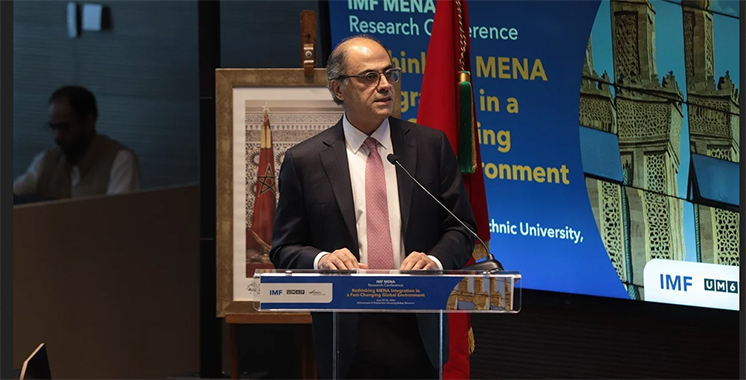
Speaking Monday in Rabat at the opening of the second annual MENA research conference, organized jointly by Mohammed VI Polytechnic University (UM6P) and the IMF, Azour said regional economies are navigating a succession of shocks tied to geopolitical tensions, volatile energy prices, disrupted trade routes, and tighter global financing conditions. These developments, he noted, have triggered significant humanitarian, political, and macroeconomic repercussions across several countries, constituting a major supply shock affecting energy markets, food security, production costs, and value chains.
Azour added that these pressures are unfolding alongside deep structural transformations, including geoeconomic fragmentation, the energy transition, and the rise of artificial intelligence, all while the region must create enough jobs for a rapidly growing workforce amid elevated debt levels in several countries. He framed the conference’s central question as how MENA economies can manage short-term shocks while sustaining long-term structural reform momentum.
Karim El Aynaoui, UM6P’s executive vice president and dean, said the conference aims to put scientific research back at the heart of public policy, calling for closer ties between academia and public institutions to help decision-makers navigate increasingly complex challenges. He argued that no universal development model exists any longer, and that each country must chart its own path through close interaction between institutions, researchers, and economic actors.
El Aynaoui also stressed the need for improved data access to support research, and described UM6P’s ambition to build an “intellectual infrastructure” through education, research, and skills development for both students and professionals.
The second annual MENA Research Conference, convened June 29-30, is held under the theme: “Rethinking MENA Integration in a Fast Changing Global Environment.” The impact of global trade, geoeconomic fragmentation, and technology, including artificial intelligence, on the MENA region is at the focus of debates.
Participants are also reviewing the role of monetary, fiscal, and labor market policies in promoting macroeconomic stability in an increasingly uncertain global environment.
The conference organizers say the war in the Middle East threatens to leave lasting scars on the region’s economic trajectory. This unprecedented shock is forcing countries across the region to reassess their path forward amid an already complex and challenging environment shaped by rapid technological change and shifts in global trade patterns.
The IMF’s engagement with the MENA region reflects its longstanding commitment to supporting countries’ efforts to maintain macroeconomic stability, enhance resilience and growth, accelerate reforms and raise living standards in an increasingly challenging regional economic environment.
The 1st annual MENA research conference was held last year in Cairo. The event seeks to establish a forum for dialogue and knowledge exchange among academics, researchers, and policymakers on major regional and global economic issues.