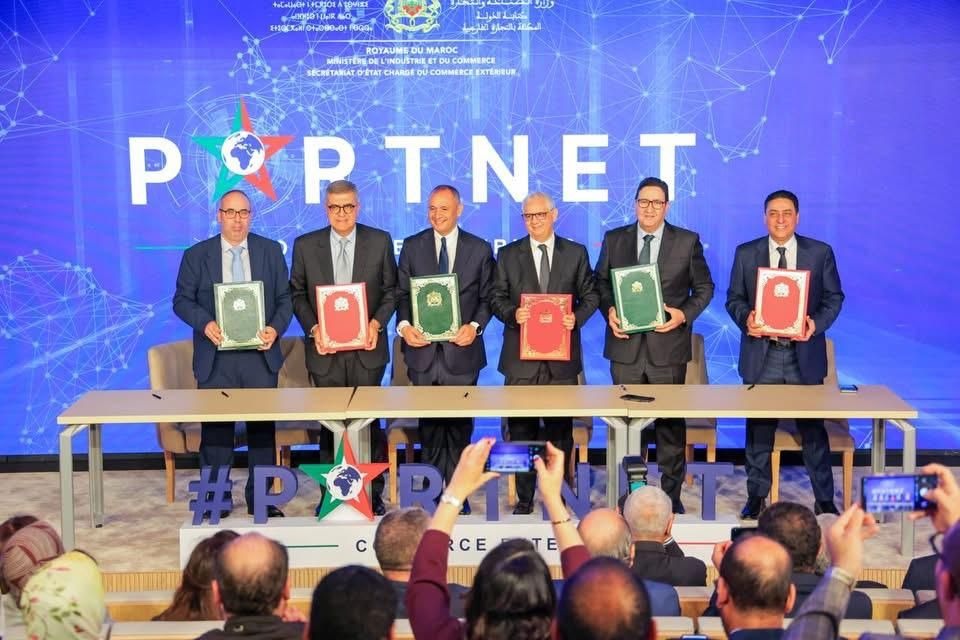
Morocco is set to overhaul the administrative infrastructure governing its foreign trade operations with the launch of a unified digital portal on 15 June 2026. The platform, developed under the aegis of Portnet, will replace a fragmented system that currently forces businesses to navigate more than eight separate interfaces to complete a single transaction — a process marked by repetitive data entry, variable processing times, and the need for physical travel to administrative offices.
The new portal will interconnect over sixty public and private organisztions around a shared reference framework. Users will benefit from a centralized, round-the-clock access point, a single authentication mechanism, and a one-time data entry system, with information reusable at every stage of the process. A consolidated dashboard will enable real-time tracking of dossier progress, supported by a virtual assistant designed to guide users through transactions.
The platform is structured around four strategic pillars: the progressive unification of existing national digital platforms; the integration of artificial intelligence for automated document reading and predictive analytics; strict compliance with Morocco’s national cybersecurity directive and ISO 27001 certification requirements; and interoperability with foreign partner systems, embedding Morocco into international digital trade corridors.
Youssef Ahouzi, Director General of Portnet, has outlined a triple objective for the initiative: data sovereignty over critical infrastructure, economic competitiveness through the reduction of costs and processing times, and the consolidation of Morocco’s regional influence as a trade hub. The stated ambition extends beyond administrative efficiency — Portnet envisages the platform evolving into an economic intelligence instrument capable of generating market analysis and integrating international payment capabilities.
Portnet’s leadership describes the launch as the beginning of a structural and irreversible transformation of Morocco’s logistical and administrative ecosystem. The initiative comes as the kingdom positions itself as a regional trade gateway, and the digital consolidation of its trade procedures is widely seen as a key enabling condition for that ambition.