Spain cannot maintain relatively open and regularization-friendly migration policies at home while expecting Morocco to shoulder the full burden of preventing irregular crossings into Ceuta and Melilla.
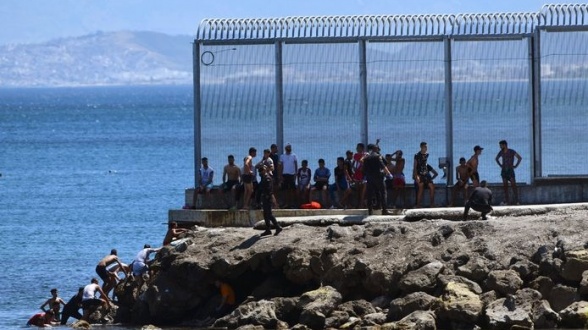
The mass influx into Ceuta last week has exposed the contradiction at the heart of Madrid’s approach. Domestic pull factors generated by Spanish decisions helped fuel the surge, yet Spanish officials continue to treat Moroccan border cooperation as an automatic obligation.
In April 2026 the Spanish government launched an extraordinary regularization process, offering residence and work permits to irregular migrants. Nearly 1.2 million applications were submitted by the end of June.
Several EU governments later described the measure as a significant pull factor. While the regularization required prior residence and offered no automatic benefit to new arrivals, its high-profile nature signaled that Spain remained one of the more accessible destinations in Western Europe for those seeking legal status.
Compounding this was a Spanish Supreme Court ruling in late June. The court held that migrants intercepted while swimming into Ceuta or Melilla could not be subject to immediate “hot returns” without due process, because they had not crossed the formal land-border infrastructure referenced in Spanish law.
Trafficking networks and social-media channels quickly amplified a simplified and often inaccurate version of the decision, presenting it as evidence that arrival by sea offered a safer path to remaining on Spanish territory.
When large numbers of predominantly young Moroccans crossed into Ceuta between 30 and 31 July, many cited circulating videos and messages claiming that Spanish rules had become more favorable.
Morocco has for years shouldered the responsibility of foiling migration attempts and countering trafficking networks on its soil, policing its coastline and accepting rapid returns under bilateral agreements.
That cooperation is not cost-free, either politically or operationally. Madrid cannot simultaneously soften its own internal rules, show leniency to those who enter by swimming, and then demand that Rabat continue acting as Europe’s primary external border guard without friction.
The pattern is unsustainable. If Spain chooses policies that increase the perceived attractiveness of its territory, it must either accept higher arrival numbers or invest far more heavily in its own border enforcement and returns capacity.
Expecting Morocco to neutralize every consequence of Spanish domestic choices is neither realistic nor equitable. The Ceuta episode demonstrates that pull factors generated in Madrid eventually register on the ground in Fnideq and beyond.