Kenya expressed on Thursday its support for autonomy for the Sahara under Moroccan sovereignty as the only credible and realistic solution to resolve the dispute, and affirmed its intention to cooperate with like-minded States to promote the plan implementation.
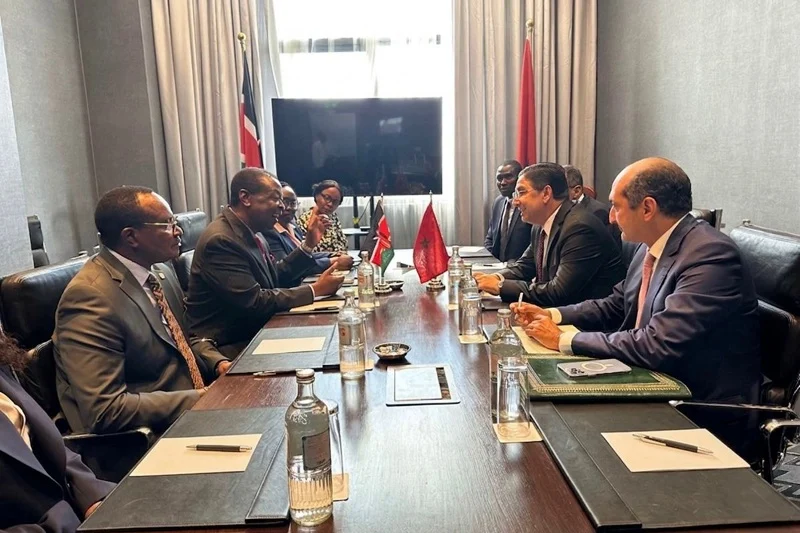
This position was expressed during the first session of the Morocco-Kenya Joint Cooperation Commission, co-chaired in Nairobi by Kenya’s Prime Cabinet Secretary and Cabinet Secretary for Foreign and Diaspora Affairs Musalia Mudavadi and Moroccan Foreign Minister Nasser Bourita.
In the Joint Communiqué adopted at the end of this Joint Commission, Kenya “welcomed the growing international consensus and the momentum driven by HM King Mohammed VI in favor of the autonomy plan presented by the Kingdom of Morocco,” describing autonomy as “the only credible and realistic solution to resolve the dispute over the Sahara.”
Deeming the Morocco-proposed autonomy plan to be a “sustainable approach” to resolving the regional dispute over the Sahara, Kenya stated its intention to “cooperate with like-minded States to promote its implementation.”
Kenya also welcomed the adoption of Security Council Resolution 2797, which enshrines “the autonomy plan under Moroccan sovereignty as the basis for a just, lasting and mutually acceptable resolution of the dispute.”
In this regard, Kenya stated that it “endorses the efforts of the Secretary-General and his Personal Envoy to facilitate and conduct negotiations based on the autonomy plan.”
In this Joint Communiqué, Morocco “welcomed” Kenya’s support for the United Nations framework as “the exclusive mechanism to achieve a lasting political solution” to the dispute over the Sahara issue.
Morocco further expressed its “appreciation for Kenya’s recognition of the Kingdom’s continued cooperation with the UN Secretary-General and his Personal Envoy to advance the political process” on the basis of the relevant Security Council resolutions.
The ministerial session of the Joint Cooperation Commission, which follows the meeting of senior officials held in Rabat last October 1-3, was marked by the signing of eleven bilateral deals covering agriculture, justice, health, maritime fisheries and aquaculture, gender equality and women’s empowerment, cultural cooperation, higher education, sports, wildlife, visa exemption for holders of diplomatic, service and official passports, as well as a framework agreement relating to the granting of university scholarships, internships and the sharing of expertise.
These agreements add to the five memoranda of understanding initiated in May 2025 in the fields of diplomatic training, housing, trade cooperation, youth, and public service capacity building.
The two officials adopted the approved minutes of the Joint Commission, which constitute a strategic framework for cooperation aimed at guiding bilateral relations in priority sectors, as well as an implementation and monitoring mechanism ensuring coordinated execution of the agreed commitments.
In terms of trade and investment, both parties emphasized the need to correct the existing trade imbalance, expand market access for agricultural and value-added products, and encourage cross-investment in renewable energy, agro-industry, pharmaceuticals, automotive and infrastructure.
They also agreed to accelerate negotiations with a view to concluding agreements in the areas of ports, avoidance of double taxation, energy, air services, mining and tourism.
Regarding connectivity, the two officials decided to give priority to the resumption of direct flights between Kenya and Morocco to boost trade, tourism and people-to-people exchanges.