Morocco has highlighted the role civil nuclear energy can play in strengthening energy security and meeting climate goals, as global demand for sustainable and low-carbon energy sources grows.
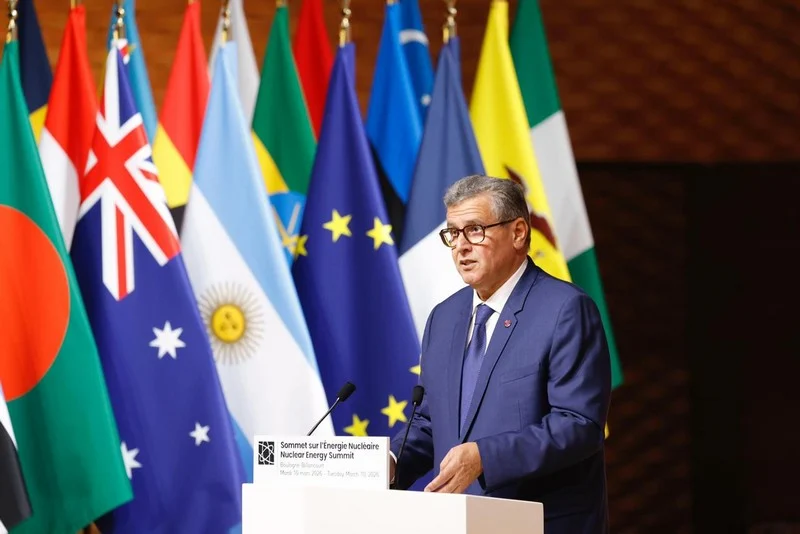
This came in the address Head of the Moroccan Government, Aziz Akhannouch delivered Tuesday at the second Global Nuclear Energy Summit in Paris.
Akhannouch, who is representing King Mohammed VI at the summit, insisted on the deep transformations reshaping the global energy sector, and pointed out that the current international context, marked by accelerating climate change, rising global energy demand and fragile supply chains, has made energy stability a matter not only of economic importance but also of sovereignty and international stability.
« In a world where energy stability is no longer a mere economic issue but a matter of sovereignty, and where global threats are undermining international equilibrium, the issue of civil nuclear power is emerging as an essential strategic lever. »
“And COP28 decisively settled the debate: nuclear energy is an essential low-carbon technology to achieving the climate goals of carbon neutrality by 2050,” he said.
Addressing Morocco’s approach, Akhannouch said the Kingdom considers responsible and gradual integration of civil nuclear power as the natural next step for expanding the energy mix. The Kingdom has a solid scientific and institutional basis in this field, he said recalling that Morocco launched an integrated energy strategy in 2009 based on three fundamental pillars: diversification of the energy mix, massive development of renewable energies, and reinforcing national energy security.
In line with the strategy, Morocco targeted that by the end 2025, renewable energies would account for more than 46% of its electricity system’s installed capacity, and would reach 52% by 2030, he said.
Beyond electricity generation, civil nuclear power opens up multiple horizons, including green hydrogen production, seawater desalination, nuclear medicine, and food security, he noted, pointing out that the Kingdom’s phosphate deposits, which hold significant amounts of natural uranium, give Morocco an additional strategic dimension in the international debate on civil nuclear power.
The Head of Government, who noted that Morocco highly values international cooperation in the nuclear field, affirmed that as “a State party to all international instruments relating to disarmament and non-proliferation, the Kingdom fully fulfills its commitments.”
He explained further that Morocco also strives to contribute to strengthening the scientific and regulatory capacities of African countries, within the framework of South-South cooperation.
The summit, jointly organized by France and the International Atomic Energy Agency, brings together heads of state and government, international organizations, and industry leaders to discuss the future of nuclear energy.
According to the organizers, this high-level meeting aims to stand out as a political framework of reference for developing civil nuclear power, complementing IAEAE’s technical fora and ahead of several international due dates scheduled for 2026, including the review conference of the Treaty on the Non-Proliferation of Nuclear Weapons.
It also provides an opportunity to reaffirm the role of nuclear power in energy security, the transition to low-carbon electricity, and industrial development.