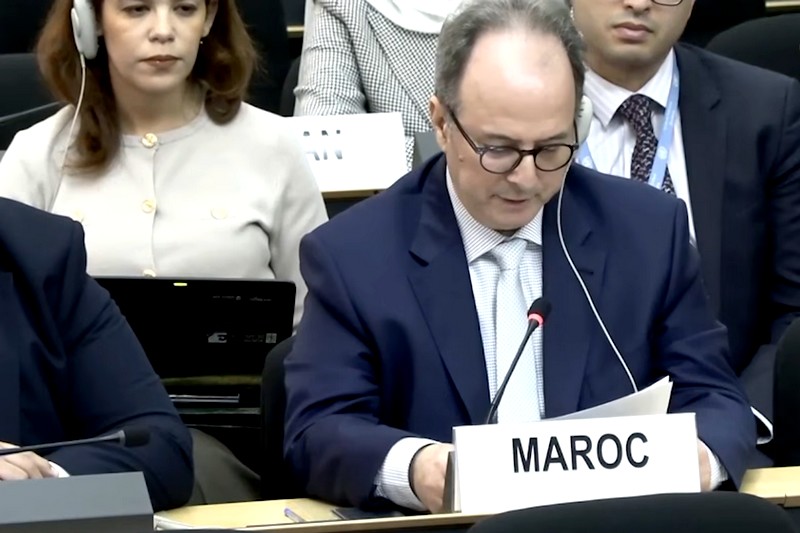
A high-level event on the role of National mechanisms for implementation, reporting, and follow-up (NMIRFs), organized on the sidelines of the 61st session of the HRC, held February 23–March 31, was convened in Geneva under the charmanship of Morocco’s Interministerial Delegate for Human Rights Mohamed Elhabib Belkouch.
The event, held under the theme “Moving the implementation agenda forward: next steps for the network and the NMIRF virtual hub,” was organized in partnership with the Office of the United Nations High Commissioner for Human Rights, as well as the permanent missions to the HRC of Morocco, Brazil, Portugal, and Paraguay, in addition to the Universal Rights Group.
The action of these mechanisms “engages the credibility of our international commitments, the capacity of our states to fulfill them, and the trust that citizens place in their institutions and in international mechanisms,” Belkouch explained.
NMIRFs are instrumental to effective reporting and follow-up of international human rights obligations and recommendations at the national level. These mechanisms serve as key, versatile government institutional frameworks that facilitate the interaction between states and the international human rights mechanisms while ensuring systematic follow-up on recommendations from international and regional human rights mechanisms.
Recognizing the key role of NMIRFs, the international community has increasingly emphasized the importance of their establishment and strengthening, including through the work of the Group of Friends on NMIRFs, led by Portugal, and an increased number of recommendations issued to this effect in the context of the Universal Periodic Review (UPR).
Several HRC resolutions, including the most recent resolution 60/27 co-sponsored by Paraguay and Brazil, also reflect this momentum. This resolution emphasizes experience-sharing among states and calls for the continued development of the National Mechanisms’ Hub (NMIRF Hub), launched on 2 October 2025, to facilitate knowledge exchange and sharing of good practices.
Building on these efforts, and following the groundwork laid by the Marrakech Declaration, adopted in December 2022 at the 1st International Seminar on NMIRFs in Morocco, the international network of NMIRFs was officially established through the Asuncion Declaration, adopted in May 2024 at the 2nd International Seminar on NMIRFs, hosted by Paraguay. The Network, currently comprising 25 member states, aims to foster collaboration, exchange best practices, and promote the establishment of effective NMIRFs globally.
The 10th Glion Human Rights Dialogue (October 2024) marked another milestone with the adoption of the Marrakech Guidance Framework (MGF), a guidance document based on good practices and a reference tool to assist states in establishing and reinforcing effective NMIRFs.
Finally, on 27 January, the Network gathered in Lisbon to adopt its action plan for 2026–2030 with six priority areas focusing mainly on peer learning and capacity building. The side event aimed to highlight key developments in connection with the NMIRF agenda, including the adoption of HRC resolution 60/27, the 2026–2030 Action Plan of the international network of NMIRFs, and the launch of the NMIRF Hub.
It also sought to present the Network and its key objectives and call for membership; show the NMIRF Hub, including the latest features; and exchange good practices and challenges in setting up and strengthening national mechanisms for implementation, reporting, and follow-up.
Moderated by Marc Limon, Executive Director of the Universal Rights Group (URG), the meeting was attended by high-level representatives from partner countries, including Portugal’s Secretary of State for Foreign Affairs and Cooperation, Ana Isabel Xavier; Paraguay’s Vice Minister of Foreign Affairs, Victor Alfredo Verdún Bitar; and senior officials from the Office of the United Nations High Commissioner for Human Rights.